

The Big Interview: Csm Sport & Entertainment – The Restructure
In part one of a two-part interview, CSM Sport & Entertainment’s Group CEO Matt Vandrau and North American chairman Harlan Stone speak to Sport Industry Group about how they got 14 agencies into three buckets; the benefit of having a leadership team with entrepreneurial backgrounds; how the new CSM hierarchy was decided; honest assessment of CSM brand and it’s future moving forward…
PART ONE – THE CSM RESTRUCTURE
How long was the repositioning planned and what was the rationale behind it?
MV: Chime came to the market in 2007 and saw that sport was on a pretty strong upward curve and that their traditional business of PR and communications was pretty flat and not growing. So they took the decision then, Chris Sattherthwaite and Tim Bell, to pursue a strategy in sport and the way for them to get in was through acquisition and in 2007 they bought Fast Track as their first business. Over the next decade they bought another 14 agencies.
We sat down at the back end of last year and had a pretty open discussion with all the business leaders acknowledging that we are a 1,000 person group in 25 offices around the world but we are not really behaving like a global business. We were still in silos, we still tended to focus on the needs of our specific agencies and if we wanted to sit in front of clients and have the ability to pitch for big pieces of global business we needed to behave like a global business. So we sat down and took the decision to take CSM as our lead brand and start the process of getting rid of the other brands.
HS: It took a bit of time as you might imagine getting 14 agencies to come together but I think what we have figured out now is that the group naturally flows into three buckets. As this was being discussed in Europe and Asia we almost independently were on a parallel path in North America and we ended up in the exactly same place which is three buckets that makes sense and our 14 business fit naturally into those buckets. We are now able to manage our activity in those three primary lines of business which are Rights, Brands and Live.
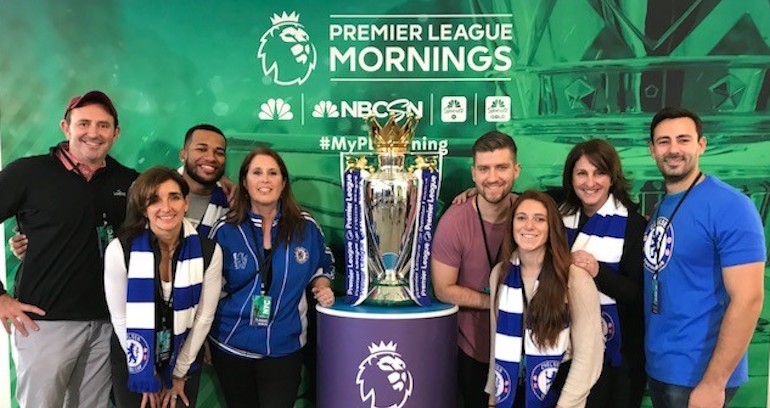
MV: A good example of this structure working recently was with Chelsea Football Club who we have a strong relationship from a UK perspective and they wanted to build their brand in North America so it was a great opportunity to take it out to our CSM colleagues over there. They have just done a great experiential piece to promote the Chelsea brand and that sort of opportunity comes from behaving like a proper grown up group.
Taking that Chelsea example, they could sit under Rights, Brands or Live depending on the work – so is the account lead by the division with the majority of the business or do Chelsea have three contacts across the CSM divisions?
MV: At the moment that is led by our Brands team but as the relationship develops with Chelsea they get a true sense of what we can deliver across the group. So if Yokohama were to come off the shirt then they need a capable rights sales team, well, we have got that and we can potentially help them find a replacement or other partners they are looking for. Plus the whole look and feel of the stadium on the production side, what was ICON and is now CSM Live can step in and help there.
Generally we will start working with a client in one capacity but like any good agency you want to work out of there are other opportunities with that client where your skill set allows you to offer a broader range of services. We need to be fluid and flexible and the structure we have put in place now allows us to do that.
Did any of the smaller clients from the previous agency structure feel that they might be too small for the new mighty CSM?
HS: I don’t know that we are quite the mighty CSM yet. I think we are actually at a really unique size. We are in a place where we can give many clients the benefit of a young, hungry agency driven by entrepreneurs. When you look at the leadership of CSM it is mostly people that have come out of small entrepreneurial environments and understand that. So I think that piece is core to us. What we have now added is the ability to deliver on a more global basis.
When you end up with an organisation that is led by entrepreneurs – we love the work. That’s what clients, at least our clients, tend to gravitate to. They know that the senior leadership across CSM are all very active in the work. I’m the Chairman of North America but I spend 70% of my time on client work. Matt is running the whole show and he is still spending a lot of time on client work. We try to preserve that, that’s a real difference and there is a bit of magic right now; we are certainly not the size of a WME-IMG or a CAA or some of the incredibly great agencies in our space. We are not an Octagon part of a holding company and yet we are not a tiny-tot as we have the ability to handle accounts on a global basis. I like our spot, there aren’t many at our size if any.
MV: That whole challenger mind-set is our ethos because that is the background to entrepreneurship. The answer to your question actually is if any client ever felt they were too small for us as our business we have lost our way. All of our clients are equally important and you never know where that small clients is going to be in a few years’ time because that’s how we all started.
This could just be semantics but are you an agency or a group or does it not matter?
MV: If you look at the way we are going now, we are an agency. We are trying to move away from being a group of 14 different businesses and we’ve made great strides in the first year. We are defining ourselves by our capabilities, there is fluidity in what we do so we can sit down with a client and make sure we are putting the best team together to meet their needs.
HS: It’s not a holding company model, we’re not a federation of businesses driving up into a fairly large centre. We have a very lean centre. We are one business with three units really as a way to help manage our business internally and also to help from an execution standpoint for our clients. It’s not meant to be a WPP or Interpublic group type of model.
MV: The perfect example of that is looking at the changes happening from a Chime perspective where Chris Satterthwaite after running the business for 15 years is stepping down as Chime group chief executive and myself and Adrian Coleman are becoming co-chief executives. So that’s taken the two biggest agencies that are VCCP and CSM and put responsibility on the two of us leading those businesses. We have this responsibility of Chime Group alongside our day jobs. So you hopefully see this holding group notion is absolutely not what we are about. With Adrian and me working closer together there should absolute be cross-collaboration of client relationships that VCCP have and that we have.
With all the different business leaders in place across the 14 agencies, was there already a natural and accepted leadership hierarchy in place or was there competition for the most senior positions in the new CSM structure?
MV: I can only speak from a personal perspective! I have never courted any of this, I was very happy running the Essentially business. Chris Satterthwaite came to me and asked if I was interested, he said that he wanted to bring the whole business closer together, that I was a pretty collaborative guy so I said sure. It was probably time for a new challenge and I was absolutely up for it. There is no lobbying that goes on here, no politics, we just aren’t that sort of organisation.
HS: I can speak with absolute 100% candour and I can speak for other leaders in the business when I say that Matt is the right guy to do it. I think there is a general feeling amongst those of us that have sold agencies that Matt is one of us, he gets it, doesn’t bring ego to the table and I think the entire group is totally on board with Matt running it.
Honestly, nobody else wants it! We all love the work so much! So to have someone who gets the work but is willing to do some of the things that a CEO has to do – that’s manna from heaven for the rest of the leadership team. Particularly someone that is even keeled, grown up through the ranks and so on. Everyone in the business is on board, it’s totally the right call.
Was that similar for selecting the heads of the different units, a natural choice?
MV: Yes, absolutely. David Webb heads up Brands, EMEA & APAC and just look at it logically, he is a very capable guy, he was effectively in JMI, our old motorsport business, running one of the biggest P&Ls in the group. In my books and everyone else’s it made complete sense for him to lead the Brand Division.
HS: And you could go right across the regions and by the person running it and it’s a logical decision why we have each person doing it. In the States we have Dan Mannix who ran the biggest experiential business so he’s running Live; I wear two hats in that I’m US chairman but been running Properties forever so Rights is my business and we’ve got a guy Rob McQueen running our Brands business.
Were any new hires key to the repositioning of CSM?
MV: The starting point was always to look within the group as we have a lot of very talented people here. I’ll use Essentially as an example, Nick Hoyle has been a part of that business for 18 years and this restructure has been a great opportunity for him to step up and run the Rights, EMEA & APAC business. The first port of call is always going to look out for the teams who have done the hard yards and broken their back for the business, who are talented. You want to give those guys the opportunity. There is nothing worse than slogging your guts off for a business and then they come and hire someone externally and stick them above you. I have always had a firm bottom up approach to challenge talented individuals to fulfil their potential.
Essentially is still an entity in its own right, will that becoming under the CSM umbrella in the near future?
MV: We need some flexibility in terms of client conversations and Essentially provides that and in the States Lead Dog provides a similar service and that’s a conscious decision. Taking 14 agencies into one will obviously turn up some client conflict challenges and we like to provide the flexibility that our clients ask for.
HS: You can’t flip a switch right there; there are other financial reasons why you might need to preserve a dual identity for a brand. We’ve made great progress having a single brand architecture but it may be another year or two before everything is purely branded CSM.
So everything will become CSM eventually?
HS: We may still keep those two strong brands Essentially and Lead Dog.
MV: Having the flexibility is great. The clients that work with Essentially love that team and similarly form a Lead Dog perspective. Never say never. I don’t know what five years from now looks like. We may be sitting here just with CSM but at the moment this way works well for us as a business.
Part two, discussing key markets, areas of growth, cause-related marketing, retainers versus project work, selling clients rights or creating your own IP, will be available next week.