






The Big Interview: Iris Sport
Sport Industry Group spoke to Nico Tuppen and Henry Scotland, managing director and managing partner, Culture, at iris Worldwide respectively, about the agency’s recent launch of iris Sport in a self-proclaimed move to bring sports marketing up to date…
What was the thought process behind your industry campaign of “needing to bring sports marketing out of the 70s”?
Nico Tuppen (NT): We observed over the years that some things hadn’t changed in the industry, it doesn’t really matter if we’d said the 70s, 80s or 90s. It felt like a lot of the deals that were being made, a lot of the ways things were being measured in the industry hadn’t changed since its inception. Still very much based on awareness metrics and media measures; easy to prove and to justify spend but we weren’t entirely sure that is getting the best out of it from a brand’s perspective and certainly not from the consumer’s perspective.
Henry Scotland (HS): It wasn’t really about the 70s and our observation wasn’t that all sports marketing was rubbish, some of the best marketing is sports marketing, but there was one particular audience that wasn’t being well catered for; partially for structural reasons like Nico just mentioned, but also some of the creativity just isn’t well suited to the slash generation (millennials). So we decided to go in on that angle, as it was one that hadn’t been pushed much, and the 70s thing was just a way to get people’s attention. It wasn’t at all what I think some of the industry thought we were saying, that you are all stuck in the dark ages; it was just a pithy point of view to open up the debate about whether or not sports marketing is doing the best job it can at engaging with arguably the most interesting consumer of today.
So did you want a debate to engage with the industry or was it just a way to get people talking about you?
NT: It was a bit of both, we definitely wanted people to notice it so it was purposefully a bit provocative and a bit shouty. Rightly or wrongly that was the strategy that we thought would be worth pursuing and it kind of worked because although some people were angry and thought this is a bit insulting, more people recognised the points we were trying to make. So from our perspective it worked really well.
Can you directly attribute any leads or new business from it or were there any negative outcomes?
NT: Without question, certainly in our experience and arguably in iris’ experience, it was the one announcement that created the most interest from potential clients, from potential talent and a lot of people getting in touch because they recognised what we were saying and they liked the challenge that it put out there.
HS: I think also those who reacted the most positively were the ones that had seen beyond the 70s reference and recognised that whilst some of the most vibrant and interesting work currently is associated with sport, potentially we could all be looking harder at the generation that we aren’t serving best. So we were pleasantly surprised by some of the brands’ responses, from people who are active in millennials’ worlds. People that thought it was really refreshing to hear our point of view which was basically that we can all do better than this.
Did you talk to your clients about it first?
NT: We did, though the reality is that we have had this point of view for years, we just hadn’t packaged it up and taken it to market. So it wasn’t really a new conversation that we were having, we talk to most of our clients about this all the time so for them it didn’t feel like a new thing.
HS: It was important our clients understood that we weren’t casting generic aspersions against rights holders and the traditional structures in the sport business, because that could have been awkward.

Onto your work, you were recognised at the BT Sport Industry Awards 2016, on the shortlist for Agency of the Year, a win for adidas in the Best International Marketing Campaign and your work helped adidas win Brand of the Year – tell us about that and what’s next with adidas?
HS: The majority of the work we do for adidas is for the global football category and we are immensely proud to have the responsibility to drive that category for them across the world, always coming from a point of view that is non-traditional; not for the sake of it, but based on the fact they are targeting 14 to 19 year olds and we’re really well set up to disrupt that audience. Our best work for them is when we develop a big social idea based on a solid football and cultural truth; we then tend to launch with a handful of carefully constructed films and pretty soon the message and sentiment are being adopted organically throughout social – and in the case of campaigns like “THERE WILL BE HATERS” and “BOSS EVERYONE” it really blows up; that’s where the slash gen take over, they identify so strongly with the message and the attitude they fully adopt it into their world.
NT: It’s been transformational for adidas, the way they talk and the channels they use and that’s been shown in all the measures you would expect from their community growth to selling more off the shelves. We’re really proud to have helped adidas identify that and execute it as well.
HS: The ambition is to make their marketing feel more like culture than marketing.
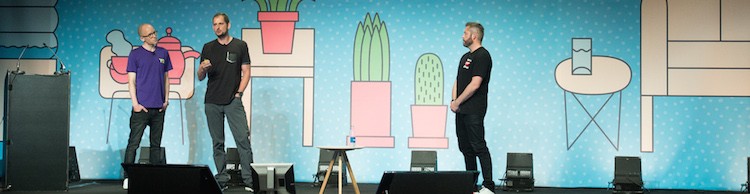
When we last saw each other was at Cannes Lions (pictured above alongside Florian Alt, Global Brand Director, adidas Football), how much do you think the advertising industry and wider marketing mix understand sport?
NT: They see sport, as we keep saying to anyone who will listen, as such a rich area for doing amazing work as it’s one of the few things left that people are genuinely interested in and care about.
What did you learn from other industries that you could apply to sport?
NT: That’s part of what our proposition is, thinking about sport as culture and therefore putting ideas forward that feel like they are a bit broader than just the sport you are dealing with. You need to learn from other bits of culture in order to keep the work interesting and vaguely memorable. A big part of the presentation we gave at Cannes was about what is it from popular culture – film, music, the internet – that we can learn and jump on the back of.
HS: Exactly, to avoid the typical clichés we raised in the original 70s press release, it’s not just about sport as effort, passion and personal achievement, but instead we must recognise it as culture.
NT: The insight that drove the ‘There will be haters’ campaign is not uniquely a sport insight, it’s a truth that exists in youth culture.
Your talk at Cannes Lions (below) was about ‘The Slash Generation’, who are they?
NT: It’s not just that we don’t like the term millennials or that everyone is bored hearing it; this is a difficult group to define purely by the year they were born and actually refers to the fact they have multiple interests and able to access those interests more on demand, on more platforms and on more devices than they ever have been, and that is a reality we have to recognise in marketing to them asap; they are into everything, and the sports marketing industry isn’t necessarily servicing all of their needs currently.
Where is the area of growth for agencies in our industry and what are the challenges?
NT: I don’t know for other agencies but as we discussed in Cannes, the commercial opportunity is massive. You have these rampant consumers and currently an industry which isn’t optimised to service their needs all the time. There is a big commercial gap there to grow into.
The challenge is there is a bit of a lag from when we start talking about these things and when the industry is ready to buy it. So from our perspective we want to be working with more clients who get what we are saying and are prepared to invest in doing that kind of work. You need to prove to clients beyond just words that this is effective and to do that you need a body of work to encourage them to start doing it in the first place.
HS: That goes across every stakeholder. The opportunity is there for everyone to revaluate how they are preparing their particular business for today; challenging rights holders, media owners, agents, brands, athletes to consider a very different model.
NT: How the industry is selling itself to get hold of sponsors’ money is under immense scrutiny. The rights holders are having to shape up and prove beyond old metrics and they have to think more broadly about the value opportunity for a sponsor. We are having those conversations with clubs and rights holders now because they understand before they resign their partners they need to prove what the opportunity is. That is a really good potential growth area, we aren’t looking to do the deals, we are looking to help both sides get the best out of the opportunity.
HS: We have probably been speaking to as many rights holders as we have brands since the announcement, which is a very promising start.
Sport Industry Group met the iris team alongside Cannes Lions TV, who also caught up with WWE stars Stephanie McMahon and John Cena about engaging content and keeping your content fresh: