






Opinion: The Future Of Stadia And Hospitality
Andy Simons, KSS director, explores the current and future trends in stadia design and sports hospitality…
The design of stadia and sporting facilities is in a constant state of flux with the demands and expectations continuously changing and evolving over time. With the ever-increasing commercialisation of sport, specifically football, many clubs focus their strategies on Return On Investment (ROI) seeking every possible use for their stadium throughout the year.
However, the ‘365 stadia‘ is not always the main priority for clubs with a few taking a different route away from the year round ROI and instead focus on building a totally bespoke stadium.
There are two different directions, on the one hand, there is the quest for the multipurpose stadia, and on the other hand, there are purpose built stadiums.
As Hugh Rosen, director of the Stadium Project Team at Chelsea FC elaborates in the national press, “To be fair to Tottenham, they are not just looking for football. They are looking for American Football, looking at rugby and as far as I am concerned if they cannot win at football, they are welcome to try any other sport they like. For us, Roman Abramovich gave us one brief, the whole stadium, the billion pounds or whatever it is going to cost, is about winning football matches. There is nothing else.”
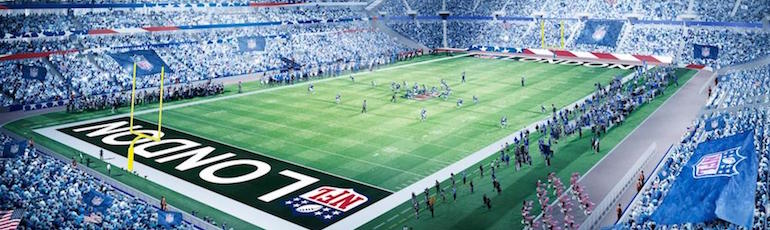
Spurs’ new stadium, with retractable pitch for NFL and football matches
Tottenham Hotspur FC and Chelsea FC are operating two completely different strategies in their new stadiums. However, both London clubs have the same goal of maintaining the atmosphere that is so often lost in new seating bowl designs. In the last few years, there has been a shift in space standards in stadia with a general trend of ‘tightening the gap’ in seating due to the demand for a more intense supporter experience. Football clubs have not particularly encouraged this change in order to lower cost and increase seat numbers and income, its actually partially being driven by supporters themselves who favour a tight and packed spectator experience.
Hospitality is also rapidly changing with the evolution blurring the lines between low-end and high-end General Admission (GA) in stadia. The ‘Pie and Pint‘ approach is gradually being phased out; there is now a massive amount of choice for everyone with a variety of different offers. It is now very hard to distinguish between top end GA and low end GA in new sports stadia around the country.
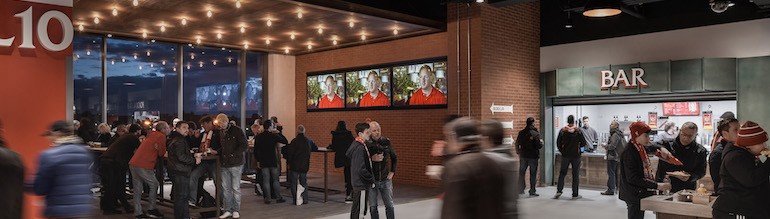
Anfield’s new Main Stand fan hospitality areas
Hospitality packages used to be based on providing the best seat in the stadium, now it is about the whole experience from the moment you enter the arena through pre and post-match gastronomic delights and network drinking opportunities. Therefore, it is crucial for clubs to get the dynamics right, and build in some flexibility in the hospitality areas to cater for every fan now, and in the future.
At the KSS designed new members’ club One Twenty within Club Wembley at Wembley Stadium, there are a variety of spaces on offer giving guests the option to spend their event in a lounge environment, restaurant or bar. The club has set a new benchmark in sports hospitality taking the traditional experience to a new level. In terms of the sheer size, One Twenty offers over 3sqm space per person, which is possibly the largest hospitality space within a sporting arena in the UK. These new and innovative approaches attract modern-day fans and those who seek the best overall experience.
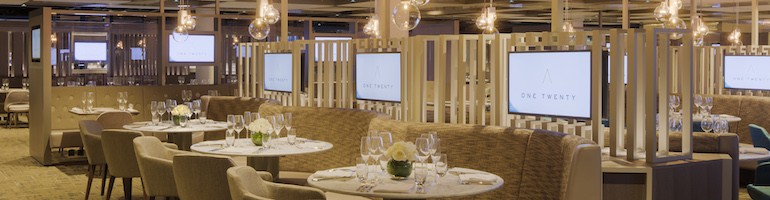
The dining area at the new One Twenty for Club Wembley
Another area in hospitality that probably needs to be reconsidered is the regulation of consumption of alcohol inside football stadiums. With Financial Fair Play, revenue generated from matchday has become more crucial, mainly to the smaller clubs. Therefore, a relaxation of the pitch side alcohol ban could make a big difference in many clubs quest for survival.
However, are people still fully engaged in the live event anymore? Are they more on their phones and tablets? The digital world has transformed the global sporting landscape with sports fans expecting their clubs to keep up with the latest technology in order to provide the greatest, fully connected customer experience. Surely, the next step is the integrated digital platform that analyses everything we do, gathering every little piece of data to provide the bespoke service modern fans are craving. This single unified software platform could then be monetised across a wide spectrum of possibilities, subject of course to the new General Data Protection Regulation in May 2018.
At our recently completed Main Stand at Anfield Stadium (main picture) for Liverpool FC such a unified ‘app’ would be hugely beneficial. Every Liverpool FC fan could buy match day tickets in the Main Stand through the integrated ‘app’, with merchandise, data and offers all tailored to their lifestyle. Then, the whole fan experience would be exactly what they want and desire, with everything almost custom-made technically to ensure the best possible experience. I believe this development is still a long way off, but certainly achievable.