





Opinion: Skins’ Chairman On Race In Sport
Jaimie Fuller, exective chairman of compression brand, Skins, talks race in sport, following ongoing protests in the United States of America and the decision by FIFA to disband its Anti-Racism Task Force…
There have been a few issues swirling around in recent weeks. The big, and ongoing, one is the continuing fallout from the McLaren Report and the more recent hacking of WADA data. So many people have written so much about this issue that I don’t feel as if I could add anything new to the debate, other than this.
It is a matter I’ve written about previously. A world anti-doping authority needs to be completely independent of the IOC, and independent of sporting organisations.
In an ideal world, it would become part of a much larger world sport anti-corruption authority that looks at governance reform, anti-corruption and bribery, doping, match-fixing, gender equity in sport and racism. Sport is crying out for it.
The second issue I want to highlight is racism and my old friends at FIFA.
Along with my colleagues at #NewFIFANow, I’ve been pretty quiet about FIFA in recent months. Deliberately so. FIFA has a president who was elected a little over nine months ago, and a CEO who started just over three months ago. We’re giving them time to get their feet under their desks and make the changes they say they will.
But it’s not a great start. There are many reasons why it’s not a great start – and we looked at some of them here after Gianni Infantino’s first 100 days back in June – but the most recent face-smacking decision is to disband their Anti-Racism Task Force.
Why? Because according to FIFA, racism in football is okay now. They didn’t bother to tell the chairman of the Task Force, and the world was not alerted to it until one of the members tweeted about the letter he received, without any forewarning, telling him it was disbanded! And this is at a time when their next two major tournaments – the Confederations Cup in 2017 and World Cup in 2018 – are being held in Russia!
All I can do is shake my head. As I said, there’s more; but it will wait for another day.
On the same theme, the third issue is around the athletes who have recently taken action against racism in their own country, the United States, by not standing for their national anthem.
In case you’re not aware of the background to this, it started in August when San Francisco 49ers Colin Kaepernick announced he would not stand for the national anthem as a way of calling attention to police violence and injustice in black America. His protest was in response to several high-profile and fatal police shootings of black American men which, regrettably almost weekly, are in the news.
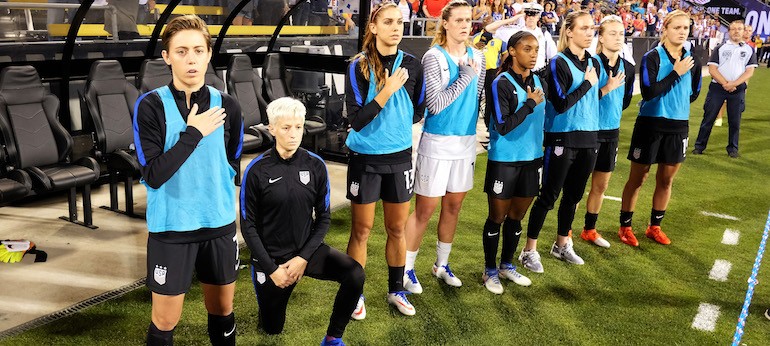
The protest has spread. Across the NFL, high school sporting events and even to national team events where women’s soccer star Megan Rapinoe (above), opted to kneel during the ‘Star Spangled Banner’ in the US women’s team recent game against Thailand. She was officially ‘warned’ by US Soccer.
What strikes me – but doesn’t surprise me – about the protest is the reaction to it.
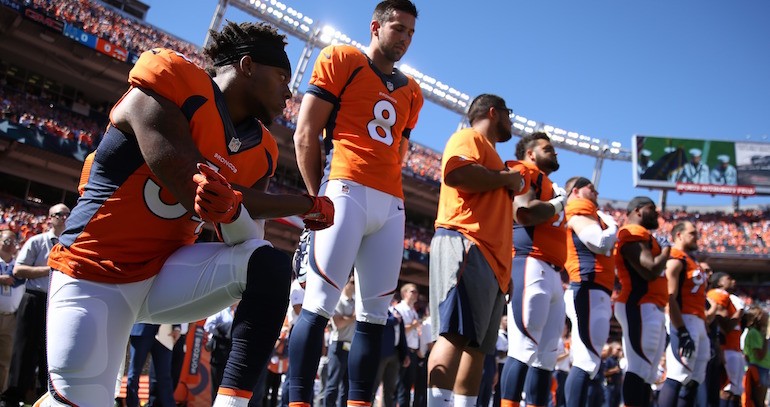
For some athletes, the action has resulted in the loss of income. Denver Broncos’ Brandon Marshall lost two sponsorships, and gained one, because he joined-in. Only yesterday in Nebraska, Michael Rose-Ivey and team mates were told they “deserved to be lynched”. Isn’t that a case in point?
Those who criticise athletes such as Kaepernick, Rapinoe, Marshall (below), Rose-Ivey and many others appear to forget about the deaths of black men and boys who have died at the hands of police in recent years. Kaepernick says he’ll stand again when he believes there has been significant change and “the American flag represents what it’s supposed to represent”.
Critics focus on the protest and the so-called ‘selfishness’ or ‘divisiveness’ of it, rather than the issue at hand: that is, racial inequality is a huge issue in the United States
In my view, Presidential candidate, Hillary Clinton, got it right in the debate overnight when she said that race determines too much – where people live, the education they get and how they are treated in the criminal justice system. President Obama recently cited research which shows that African-Americans are 30% more likely than white Americans to be pulled over by police, three times more likely to be searched, twice as likely to be arrested and twice as likely to be shot by a law enforcement officer.
For me, the action is a powerful symbol. For its time and cultural context, it is as important as the one I wrote about here in respect of the Mexico City Olympics and the action of John Carlos, Tommie Smith and Peter Norman.
Image: ©Getty Images