






Opinion: Why It’s Not Boxing Vs Mma
Ahead of one of the most highly anticipated sporting events in recent years – which sees boxing legend Floyd Mayweather meet UFC poster-boy Conor McGregor in a pure boxing bout – PHA Media‘s resident combat sports expert Sarah Taylor, who also heads up the agency’s UFC account, explores what this historic fight means for the world of combat sport and why it’s not simply a battle of boxing vs MMA…
Following months of rumour and speculation, on 14th June UFC lightweight champion Conor McGregor confirmed that he would step out of the UFC Octagon and into the boxing ring to meet the undefeated, five-division world champion Floyd Mayweather. The bout, set to take place on Saturday in Las Vegas, will see McGregor – the most lucrative, high profile mixed martial arts (MMA) athlete in history – take on Mayweather – arguably the greatest defensive boxer of all time – as the audacious Irishman looks to become the first practitioner ever to translate MMA success into boxing triumph.
“A billion dollar gimmick” said Mail on Sunday’s Oliver Holt. A sporting “freak show” said The Telegraph’s Tom Cary. A match up for “the gullible based on nothing but greed” said The Times’ Ron Lewis. It’s fair to say that the idea of this so called ‘super fight’ actually taking place has proven more polarising than the personas of the two men set to throw down inside the T-Mobile Arena on the night.
Nevertheless, the bout has sparked an unprecedented level of intrigue amongst sports fans worldwide. When the two athletes embarked upon a world press tour to promote the fight, millions of people tuned in to watch the drama unfold and the event trended at number one on twitter worldwide. UFC’s Embedded Vlog series, meanwhile – providing a behind the scenes glimpse into the build up to the fight – received more than 2.6 million views in just two days. It is therefore unsurprising that May/Mac is expected to outstrip all previous pay-per-view records – including that of Mayweather vs. Pacquiao (which reportedly enjoyed 4.6 million buys) – to become the largest-grossing fight in history.
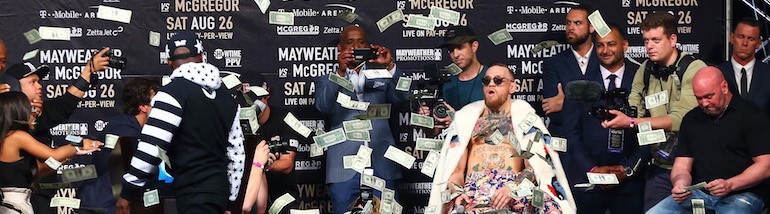
Understandably, the fiercest criticism to date has come from boxing purists who feel the bout is being driven purely by the desire for financial remuneration. But the uproar that such a money-driven match up could ever be made inside the boxing ring is, to many, somewhat surprising. After all, some of the biggest fights in boxing history were made based on money, publicity and bravado. The difference, on this occasion, is that one of the two men set to dance at the top of the bill is not a professional boxer.
Boxing is a sport steeped in history. There is therefore an understandable desire from loyal fans and pundits to protect and preserve it. However, it is difficult to argue with the notion that boxing is in grave need of rejuvenation. As The Sun’s chief sports writer, Dave Kidd, aptly put it this week, ‘boxing is in the grip of either a lengthy drought or terminal decline’. And what boxing lacks, MMA oozes – youth, vivacity and digital nous. UFC, as the biggest powerhouse in MMA, continues to lead the way when it comes to engaging audiences with cutting edge social techniques and unrivalled access. With an estimated 274 million fans worldwide and a commitment to remaining at the forefront of digital innovation, it’s no surprise that UFC’s social audience now stands close to 60 million.
But while MMA may today enjoy a reputation as the younger, more captivating form of sporting combat, its ambition is not now, nor has it ever been, to eradicate boxing. Far from it. UFC president Dana White himself remains a lifelong boxing fan and continually discusses how boxing and MMA should continue to co-exist. While boxing, on one hand, has long enjoyed the bright lights of the mainstream sports stage, mixed martial arts – in its modern day form – on the other, is still in its relative infancy. And so what MMA lacks in heritage and mainstream sporting status, boxing enjoys by the bucket load.
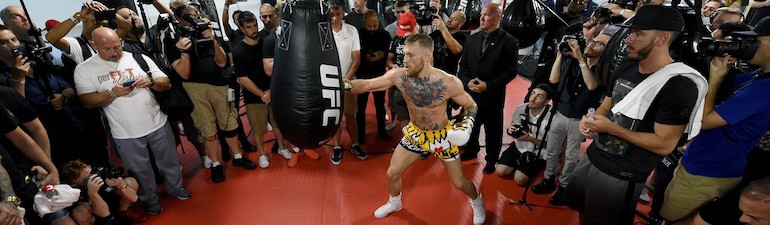
It is for this reason that the two combat disciplines – enormously different in so many ways yet remarkably similar in others – should, and indeed must, co-exist in a bid to challenge and drive one another forward. Put simply, the growth of MMA need not mean the demise of boxing, in the same way that a resurgence in boxing should not suggest stagnation or failure for MMA.
Many have contended that, should McGregor be defeated on 26th August, the MMA world would be shaken. Just this week former boxing champion Amir Khan told BBC Radio 5 Live that a victory for Mayweather would cause UFC fans to turn their backs on MMA and move towards boxing. Those people – and Khan himself – are underestimating the fan base that MMA enjoys.
Passionate, educated and fiercely loyal, fans of MMA will defend their sport until the bitter end. McGregor, meanwhile – the man responsible for the meteoric rise of MMA – has built an army of followers around the world who cling to his every prediction, imitate his impudent rhetoric and write songs about the power of his left hand. Even McGregor’s first UFC loss in 2016 – which came at the hands of one of the sport’s most loved characters, Nate Diaz – did little to shrink the Irishman’s stardom, and McGregor has since gone on to build a social media fan base in excess of 28 million. When the young Irishman has fallen, his fan-base has remained firmly in place. I struggle to see how losing at the hands of one of combat sport’s fiercest competitors – in a discipline that he has never sought to specialise – could trigger a reaction any different.
Ultimately this is a spectacle of sports entertainment, an opportunity to witness two of combat sport’s all-time greats go head to head. It is not about the demise of either athlete or indeed the abandonment by fans of one sport in favour of another. Regardless of the outcome, Mayweather’s legacy as one of the greatest boxers ever to step into the ring will remain, while McGregor will continue to be viewed by many as one of the most accomplished and dynamic combat sports athletes in history.
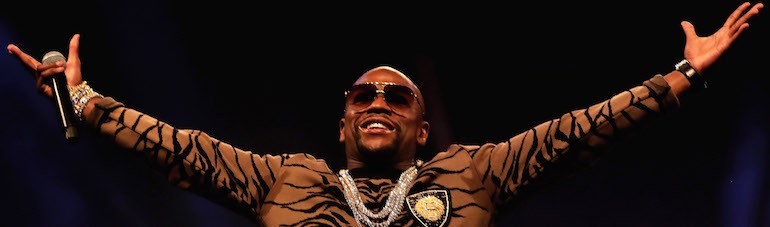
The profile of combat sports, meanwhile, will grow exponentially either way. On one side, this fight could trigger the very resurgence that boxing has been crying out for. On the other, the event has created a huge opportunity for MMA as a sport to engage with new fans, and to introduce them not only to the spectacle of UFC but also to the phenomenal – yet hugely underappreciated – athletes who feature on the UFC roster, and who themselves have the potential to go on to become superstars in their own right.
Mayweather vs. McGregor is set to be an extraordinary event, which has the potential to break records. But importantly, as boxing and MMA journalist Gareth A. Davies fittingly put it, it’s also yet another sign that ‘the tectonic sporting plates are shifting’.
MMA is, without doubt, moving into the mainstream. But boxing should not live in fear; this town is big enough for the both of them.
Images: ©Getty Images