


Our Future Health And The Power Of Sport

SAM COLLEY
Our Future Health
Our Future Health is aiming revolutionise the way we fight disease by collecting information from millions of volunteers across the UK, to help researchers find ways to prevent, detect and treat diseases earlier.
Sam Colley, Our Future Health’s Sports Partnerships Manager, explains how, by embracing the UK’s largest health research programme, sports brands and ambassadors could help shape the future of healthcare.
In 1966, Muhammed Ali did something that made headlines around the world – and it didn’t involve throwing a single punch.
Ali refused to be drafted into the US Army to fight in Vietnam. His stance earned him a five-year prison sentence, but it also helped change the narrative around war protest. The man they called The Greatest showed just what an athlete could achieve without even stepping inside a stadium.
“Ali’s actions changed my standard of what constituted an athlete’s greatness,” William Rhoden, columnist for The New York Times, wrote at the time. “Possessing a killer jump shot or the ability to stop on a dime was no longer enough. What were you doing for the liberation of your people? What were you doing to help your country live up to the covenant of its founding principles?”
What, in other words, were you doing to help your fellow human?
MAKING A DIFFERENCE
Skip forward 60 years and our sporting stars now have an almost unparalleled power to change the world. Modern technology has widened their influence since Ali’s day, allowing them to reach a truly global audience. As Liverpool goalkeeper Adrian recently said in an interview with The Athletic, “Social media can be a crazy world, but as football players we can use it as a force for good to help educate people. We have the platform to make a difference.”
Today, examples abound of sport being used for good. Within the past few years, we’ve seen Manchester United’s Marcus Rashford campaign successfully on free school meals, and the England women’s football team push for girls to have equal access to sports at school. Over the summer, Graeme Souness swam the English Channel to raise over £1m for children with epidermolysis bullosa.
Health projects represent a natural opportunity for sport to make a difference. Sport and health are closely related – one leads to the other. And everyone wants good health, whether for themselves or for their family and friends. That’s why, as the person responsible for sports strategy at Our Future Health, I’m leading a drive to find our next partners from the sporting world.
NO ONE GETS LEFT BEHIND
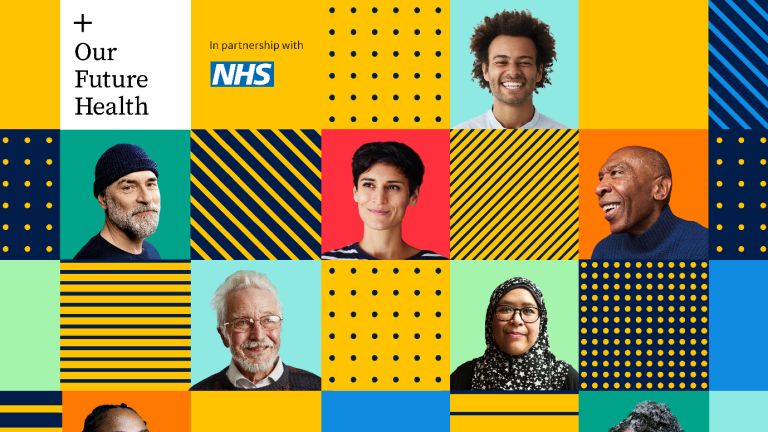
Our Future Health is bringing together up to five million people from across the nation. Our volunteers donate their health information so that researchers can find new ways to prevent, detect and treat common diseases like cancer, diabetes, heart disease, stroke and Alzheimer’s.
Big picture, Our Future Health can change the way healthcare is delivered. Rather than waiting for symptoms of a disease to show, doctors will be able to detect a disease earlier in its development and stop it in its tracks. It means people will live healthier lives for longer.
Crucially, the programme is designed for everyone – we are committed to building a resource that truly reflects the UK population. In the past, some groups have lacked representation in health research programmes. This includes people from Black, Asian, and lower income communities. In contrast, by prioritising diversity, Our Future Health will lead to discoveries that benefit everyone.
“Our Future Health can change the way healthcare is delivered. Rather than waiting for symptoms of a disease to show, doctors will be able to detect a disease earlier in its development and stop it in its tracks.”
As an NHS GP, Our Future Health participant Dr Amos Ogunkoya is encouraging everyone to join the research programme. “Getting people from all backgrounds to take part is a vital step in closing the gap in health inequality,” he says. “I want everyone to feel that healthcare is for them.”
Unlike traditional charity partnerships, Our Future Health is not looking to fundraise through our sports partners or their audience – we’re funded by an ambitious collaboration between the public, charity and private sectors. For our volunteers, taking part is free. As one of our volunteers from Birmingham, Linda Harris, puts it, “I don’t have oodles of money to give to charity, so something like this is something positive I can do.”
What’s more, by joining Our Future Health, participants have the option of getting feedback on their health, including their blood pressure and cholesterol levels. For many, it is the nudge they need to change their lifestyles for the better.
CHANGE THE WORLD FOR GOOD
In November, we welcomed our one millionth volunteer to our programme, barely a year after opening our doors to the public. But we still need many more. Our aim is to recruit five million adults. It’s a huge target but, once reached, it will place the UK as a world leader in preventative medicine.
Sports brands can be part of this ambitious story by engaging the nation in what we’re doing. Put simply, it is your chance to help your fellow human.
“We’ve seen a significant rise in both brands and rights holders using their platforms to make positive change in society,” says Charlie Weir, founder of sports marketing agency WeAreNinety, pointing to FEVO Sport Industry Award-winning campaigns by Arsenal (youth crime) and The FA (Let Girls Play). “It is both great for society and beneficial for the brands and ambassadors involved.”
“Sport can once again play a role in positive change, this time for the country’s health. The ambition of Our Future Health is unprecedented, but this industry could help them achieve their goals.”
With your help, we can prevent disease together.
Visit ourfuturehealth.org.uk to volunteer today.