



Sid Lee London: Finding Fame
Fame is the single most effective objective any campaign can have. Rory Natkiel, Head of Strategy at Sid Lee London, has explored how the sports marketing industry can get back to producing iconic, enduringly famous work.
I can still remember iconic moments from the famous sporting ads of my childhood…
Honey Monster at the back post for Newcastle.
If you want to be like Linford, you’ve got to think like Linford.
Gets to your thirst, fast.
Accrington Stanley? Who are they?
Can you think of any recent sport campaigns that have embedded themselves in the collective memory in the same way? Perhaps Nike’s ‘Dream Crazy’ with Colin Kapaernick, but if anything that’s the exception that proves the rule. When it comes to famous marketing campaigns all the running over the last 10 years has been made by insurance comparison sites and high street retailers.
Something has happened in the sport marketing industry that means we aren’t producing iconic, enduringly famous work.
This is a big problem. Fame is the single most effective objective any campaign can have. Les Binet and Peter Field identified this over 10 years ago in their IPA paper ‘The Long and Short Of It’: whether you’re seeking market share, sales, profit, penetration, loyalty, or reduced price sensitivity, “fame driving campaigns outperform others on all business metrics”. The Marketing Society found a similarly direct relationship in their multivariate model: “as fame increases, so market share increases”.

Put simply, if you want results for your brand, fame trumps everything. Which is why, at Sid Lee London, we view fame as the goal for everything we do.
Now this may all sound quite obvious. We all want to do famous work, right?
But then why are sport brands failing to achieve it?
FAME BEATS AWARENESS
Firstly we need to reconsider how we think about fame. For many in sport marketing, ‘fame’ would typically be some combination of approval by our internal stakeholders, a good response when we post our campaign on LinkedIn, positive coverage in Campaign or AdAge, and perhaps picking up industry awards.
But we need to remember we are not the audience. The average person doesn’t pay much (if any) attention to brand communications, even if they’re from a team they support. And they certainly don’t read Campaign.
And so being the recipient of a pat on the back from the rest of the marketing industry, as satisfying as it may be, doesn’t mean you’ve achieved true fame.
Binet & Field define fame as being “not simply about generating brand awareness. It is about building word-of-mouth advocacy for the brand – getting it talked about, creating authority for the brand and the sense that it is making most of the running in the category.”
And so here we see a crucial definition of fame. It’s about creating campaigns that people enjoy, remember, and talk about with their friends, family, and colleagues.
Sure, everyone’s heard of you. But when was the last time you put out a campaign the average consumer could remember a year later?
What about 10 years?
POPULARITY BEATS PURPOSE
As an industry we’ve not only been thinking about fame wrong, we’ve ignored what makes campaigns famous in the first place. Our industry’s focus on purpose over the past decade has meant many brands have forgotten a much more powerful tool: popularity.
The Ice Bucket Challenge didn’t become a worldwide phenomenon because of its purpose to end ALS. Hundreds of fundraising campaigns a year try to do that.
It became famous for a much simpler, perhaps even puerile reason: it’s funny to watch people’s reactions when they have a bucket of cold water poured over their head.
Earnestness and sincerity have their place, but why did we forget to have fun, be original and most importantly, memorably quotable and popular?
Because let’s not kid ourselves – people know when they’re being marketed to. But they tend not to mind it too much if it’s an enjoyable experience. The fact we’ve forgotten this simple principle is clear when you look at the famous TGI chart showing the decline of people agreeing ‘I enjoy TV ads as much as the programmes’.
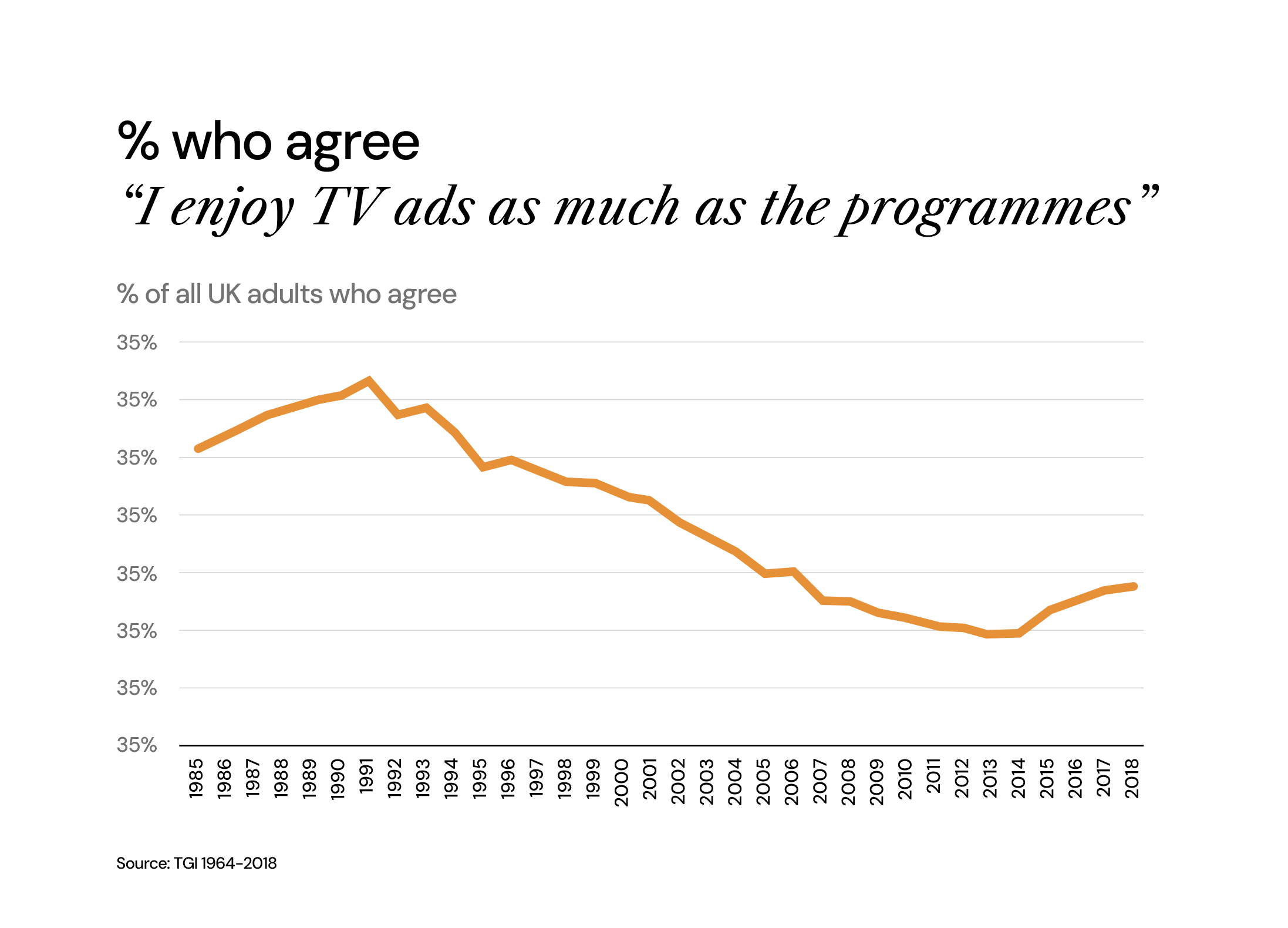
In aspiring for a more worthy pursuit than profit, brands have forgotten the kinds of campaigns the public truly enjoys. Humour, lovable characters, well known tunes, plays on words, quirky accents, ‘aha’ moments: these are the things that have always captured the attention of the public.
By striving for authenticity we’ve forgotten all these things and defaulted to a style of advertising that desperately tries not to look gimmicky, or actually anything like advertising at all.
And in doing so, we’ve eschewed many of the things that stand a chance of making our work popular in the first place.
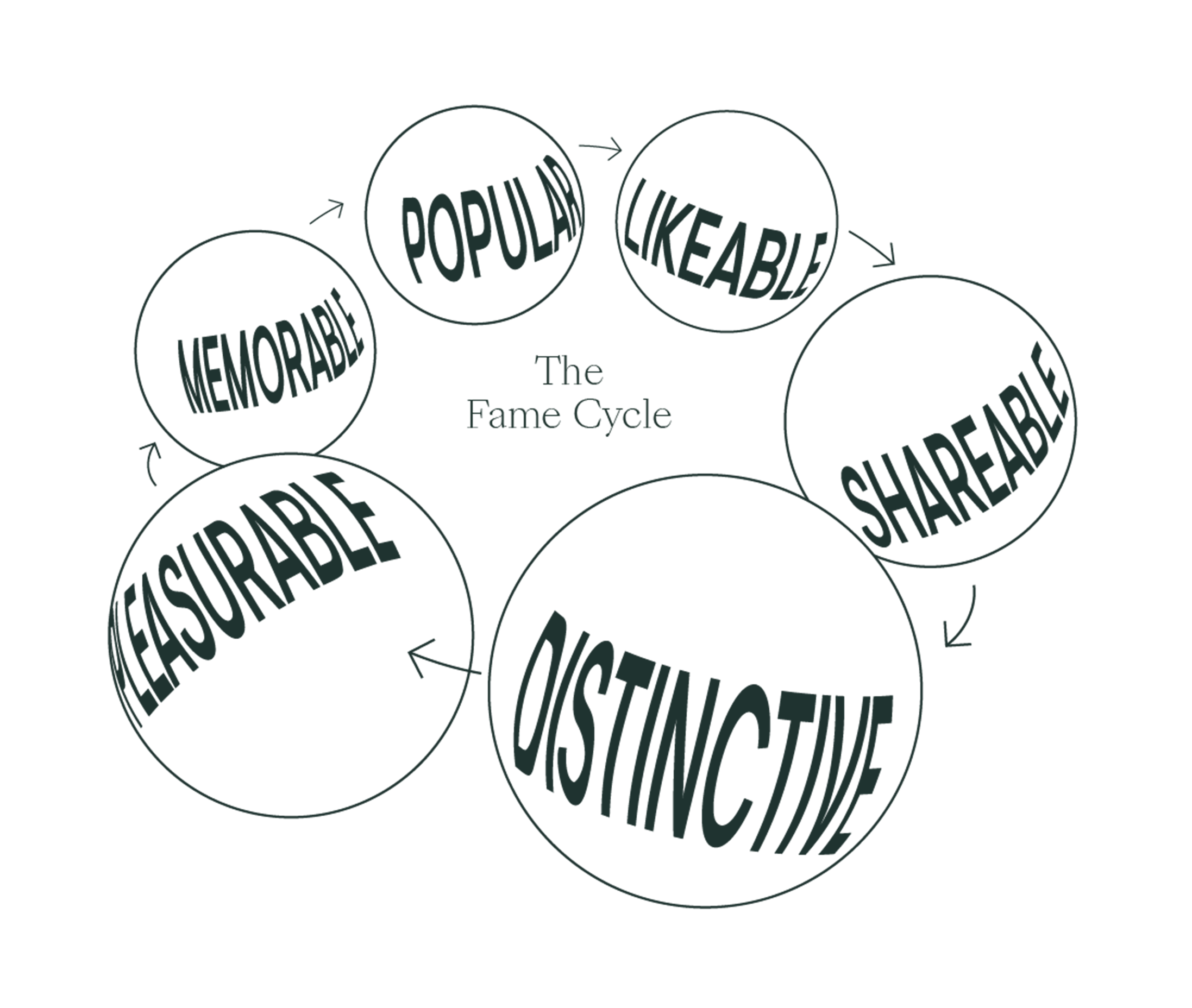
THE FAME MINDSET
In his excellent book Why Does The Pedlar Sing, Paul Feldwick observes that if you look at many of the most famous people in the world, from Victoria Beckham to Donald Trump, from Dr Dre to Ryan Reynolds, they share a few characteristics: an intuitive understanding of their audience, the willingness to take risks, and an ability to react quickly to opportunities.
They have also grown their fame in many different areas of popular culture. Dre moved from the world of hip hop performance to pop producer and onto consumer tech; Reynolds from Canadian TV to American movies, on to the alcohol industry and then to the world of football ownership.
In each instance they grow their fame in one area before moving onto another, growing their overall fame as they do.
You can see this principle in action with the Super Bowl and the effect of Taylor Swift’s participation in the US’s biggest sporting event. The worlds of pop music and sport came together like never before to see the 2024 Super Bowl overtake the moon landing as the US’s largest ever TV-audience, and enter the popular conversation in the UK in a way that I (as a die hard NFL fan) have never experienced before.
In the process Taylor Swift’s fame has grown even further among the NFL fanbase, while the fame of Travis Kelce, the Kansas City Chiefs and the NFL itself has grown in turn.
What’s this all got to do with sport marketing?
Well it should be clear that fame isn’t built by ‘staying in your lane’. Campaigns can’t succeed through one channel. You won’t build fame through a social content series alone.
For sport marketers, fame is the result of consistently and repeatedly aligning what at Sid Lee we call the ‘building blocks of fame’ in surprising ways. You need to consistently delight your existing audience, while always being ready to seize opportunities to reach new ones.

WANT MORE THAN 15 MINUTES?
Put simply, at Sid Lee our fundamental principle is that the key to commercial success for any brand is to aim for fame. From there all else good follows.
And while nobody can ever guarantee fame, we can always create the conditions for it. To do this there are some key questions to ask when you are planning your next campaign:
- What is entertaining and appealing within this campaign for the end consumer?
- Is there anything at all – an iconic character, line, piece of music, joke or image – that has a chance of being remembered by the average person (not your boss or your Mum) in a year’s time? What about 10 years’ time?
- Have you integrated a variety of touchpoints, channels and people to execute the campaign in interesting, surprising or new ways?
- How will this encourage the audience to participate in the idea and spread the word to their networks?
If you have answers to all of these questions, then your brand might just live forever.

Stay up to date with the world of sports business by subscribing to the Sport Industry Daily.