



#sinextgen Meet The Coaches: Craig Preston
Craig Preston, managing director at Inspirational Development Group – a business performance improvement consultancy, focusing on leadership, followership and partnership behaviour – speaks to Sport Industry Group about his journey from military to business and his role as a Sport Industry NextGen Coach…
Tell us about your leadership journey to date and what your role at IDG involves now?
My background was in the military where I spent just over 18 years, mainly in the infantry, and served in all sorts of places around the world with the operation service, from Northern Ireland to Bosnia. After I left the army I went to work for Coca- Cola where I spent four years in a variety of operational and sales management roles before joining IDG for the first time. I spent four years at IDG working with clients in finance and some other sectors including sports. I then moved to AON where I was a terrorism consultant. In the midst of that I took a short time out to be the head of people development for the RFU. Then, three years ago, I came back to IDG as managing director and I have been here ever since.
What does IDG offer clients?
We are a performance consultancy, we improve our client’s business performance by changing the behaviour of leaders and teams, across all levels of their organisation.
IDG is not a training company, we are a performance business and we develop our client’s business or performance requirements by working with them to help support and improve their team’s behaviour. That means face-to-face time with our clients either individually or collectively.
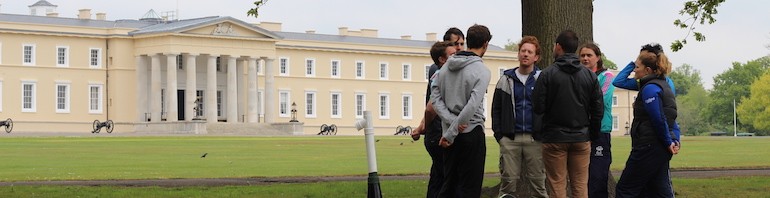
We work all around the world and we deal with offices in India, in the middle east, Dubai and Cape Town, as well as a large office in Sandhurst where we work in association with the Royal Military Academy. This gives us incredible access into the Royal Military Academy and benefit from some of the high performance, leadership and team behaviours that the academies have developed over 200 years, which are as applicable and effective now as they have ever been. The academy provides young leaders into the army, into an environment where they have to be able to achieve their objectives. What they are taught is highly effective and has to be relevant because there is no scope for failure once they have left the academy.
We bring clients in and develop them over time, ideally interacting with them on a number of occasions to ensure that behaviour will change and will be sustainable and won’t evaporate over time.
Our consultants are a mixture of people from military, professional services and also from business, but they all share an experience of leading themselves and others at a variety of levels.
What could you provide for anyone new to IDG, Sandhurst, or leadership training as a whole?
Clients who come to Sandhurst are not coming for a bootcamp. The focus is on leadership and team behaviour and working effectively as an individual and as a group.
We draw on the leadership team philosophy that Sandhurst has developed, so the programme is values based and aims to build trust, mutual understanding, respect, confidence, communication and offer a safe place for people to demonstrate courage. The activities can often include a physical element but only at the level that is appropriate for the client, so it does help when people can get outside, conduct activities and experience success and failure as a team. Problem solving in a unique environment is a mental skill, so the focus isn’t on developing physical ability, it’s on developing effective behaviour.
We also draw on the impact that the environment has on people, which in itself affects people’s behaviour. There is clear message between environment, behaviour and performance.
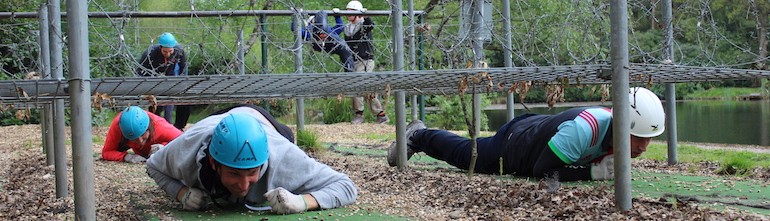
In your role as a Sport Industry NextGen Coach you have met several of our Leaders already, both at the 24-hour experience at Sandhurst and during the Development Afternoon. How have you found the experiences with the group so far?
Without hesitation I would say that working with the Sport Industry NextGen Leaders has been a hugely impressive experience. Those I have met are already extremely high quality, with huge amounts of potential, and have a real appetite for developing. It means that it is very easy and fulfilling to work with them because they want to improve and, without doubt, high performers have an appetite for development.
I have been impressed with the clarity of their own personal visions, in that a lot of them really know where they want to go and they are very clear in their own personal values and standards, and are more than happy to defend them. I saw examples of how they demonstrated courage by often standing up for things that they believe in, while taking educated risks based on feedback from their peers, which is a fundamental component of being an effective leader.
They often came across mature beyond their years and I don’t think I met one person that I wouldn’t be happy to have on my team. I think the selection process for the programme is extremely effective.
General Montgomery’s definition of leadership is “the capacity and the will to rally men and women to a common purpose and the character which inspires confidence” so first and foremost you have to want to lead. If you don’t want to lead you are never going to be effective.
I know that there are examples of people that default into leadership roles through a family business, or other people around you have moved elsewhere and you suddenly find yourself in the leadership position as last person standing, but the most effective examples of leaders are the kinds of people that take that step up and say ‘I want to do this, I want to take up the responsibility’.
That is the first step. The second step is to give those people the confidence in themselves and those around them. The Leaders that I have met, they are really impressive characters. You have confidence – even in the early stages of their careers – in following them.
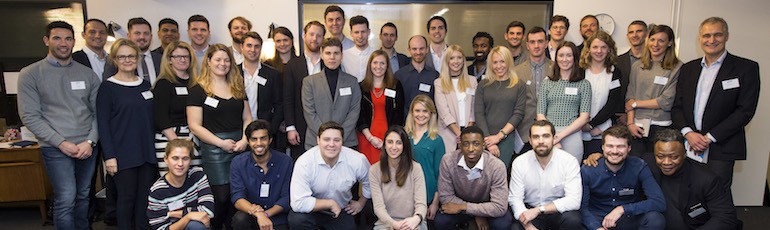
As they go through their careers a number of them will get bumps and knockbacks and failures and so on, but there will be a significantly high proportion of those on this programme that will be extremely successful. They are inquisitive, challenging and they listen.
How important is it to help future leaders to the next step? Could potential leaders make it there themselves, or do you need that structure and development has to be in place in order to succeed?
Some leaders can become successful intuitively for sure; they learn from their own mistakes, but crucially those type of leaders are self-aware and will often seek out feedback themselves as they go along.
That intuitive self-regulation doesn’t appear in many people to begin with though. Leaders who’s potential to lead has been identified will be just as effective by going through formal development and that has been the case with the armed forces for generations. There is no doubt that a young leader coming out of Sandhurst is that much better because of the development they have had and simply could not do the job without it. For others, any formal development will be a benefit but the key thing for young leaders for me, is to see leadership as the key component of their job role and to study and develop it as much as they would study and develop a technical capability.
They should observe leaders, consider their strengths and weaknesses, read about leadership, qualify themselves whenever they can and see it as something that is an art, not a science. Those that see leadership as an inconvenient addition to their technical job are the ones that tend to fail. Those that embrace it because it is the core of their job, with a will to help other people to perform are the ones that will eventually succeed.
Finally, what can people gain from being seelcted as a Sport Industry NextGen for 2018?
I would say there are three main components to what you will gain from this:
1 – you will be personally challenged by the content of the programme and the quality of the people around you.
2 – you will benefit from building a network across the industry that will help you in the short, medium and long term
3 – you will benefit from the leadership package of the programme because it will help that part of your role.
A challenge, a network and tailored content. With those three, you can’t go wrong.