





Nissan Creates Cutting Edge Trike
Nissan, an official partner of British Paralympic Association (BPA), has used its automotive expertise to support some of the British athletes at the Rio 2016 Paralympic Games, revealing some of the details behind a new trike for three-time Paralympic gold medallist David Stone MBE.
The team has worked in partnership with the English Institute of Sport (EIS) and British Cycling, the Nissan Innovation Team based at the Nissan Technical Centre Europe (NTCE).
The Nissan Innovation Team began the project in 2014, following many of the same procedures involved in designing a car. Afer a full 3D laser scan of David’s existing trike by Nissan Design Europe, a process usually reserved for styling clay models, the team established his new trike could be made lighter than his existing steel/carbon hybrid and his riding position lowered to significantly improve his speed and stability.
The team chose to design the new trike using Titanium Grade9, achieving weight savings of 18%. Their approach followed the same basic material and design philosophy that was applied to the lightweight titanium exhaust system on the Nissan GT-R NISMO.
Utilising titanium over steel also allowed Nissan to stiffen up the frame, which is key for transferring the power between rider and road. To measure the stiffness of David’s current trike, modal analysis was conducted by Nissan engineers, where sensors were placed across the frame to measure its resonance.
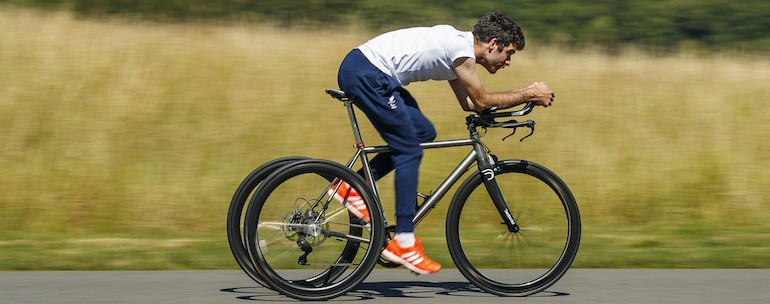
Throughout the process Nissan also adopted various other techniques such as ‘coast down testing’ of the trike on a track – similar to that used to calculate the aerodynamic efficiency of cars – and allowed David to have access to their environmental chamber where he prepared in high temperature conditions as part of his training programme.
Alec Patterson, R&D project manager, who led the team of innovation experts at Nissan Technical Centre Europe (NTCE) explained: “Nissan initially discussed with the EIS the ways we could utilise our engineering development expertise for the benefit of Rio 2016 – bound Paralympic athletes. The David Stone trike project was chosen as it offered potential for significant improvement and could directly benefit from our in-depth experience of vehicle design and manufacture.
David Stone commented: “It’s been an extremely exciting couple of years working with Alec and the Nissan Innovation Team in Cranfield. I never imagined that I would have access to a team of engineering experts who would be able to create something so bespoke for me. I’m looking forward to riding the new trike in Rio and hopefully making everyone back in Britain proud.”
Tim Hollingsworth, CEO of the British Paralympic Association added: “We’ve been delighted about working with Nissan on our road to Rio 2016, and have been excited about the innovative approach they have brought to the partnership. Having access to the expertise and knowledge within the Nissan Innovation Team to benefit some of our athletes is something truly special that they have and hopefully it will help assist the ParalympicsGB team in having a successful Games in Rio”.
In addition to the trike project, Nissan has also provided consultancy to the EIS on various other aspects of how the British Paralympic team’s equipment could be optimised ahead of Rio. This has included support on identifying a new type of wheelchair roller for athletes warming up ahead of races, feedback on materials for wheelchair athlete’s gloves and input on the best types of testing methods for grip testing wheelchair tyres in various weather conditions.
Nissan also offered support to ParalmypicsGB T54 sprint competitor, Richard Chiassaro, by providing him with a new wheelchair after his was vandalised in December 2015.