







Show Me The Money? Start With The Data
Jon Rosenblatt, CEO of Brandtix, a London-based sports data company, on how data is helping top brands and teams put a true price on the world’s biggest stars…
Since Cuba Gooding Jr and Tom Cruise yelled ‘Show me the money’ to each other in Jerry McGuire in 1996, the phrase has become synonymous with athlete sponsorship. Whilst the phrase – and sentiment – has stood the test of time, the process by which an athlete is selected on or off pitch is possibly one of the most seismic changes in sport.
Central to this evolution is data; Billy Beane’s Moneyball was a clear demonstration as to how this applied for selection, and now commercial partners have access to this degree of insight too. New analysis means that players are monitored in real time for on-pitch performance via Opta, social media activity and the resulting fan sentiment for both. For example, the Brandtix platform uses over 100 different metrics for live analysis, which are then rationalized with a number of detection algorithms, resulting in an overall Index Score.
The latest generation of metrics are truly ground-breaking as they calculate real-time brand sentiment alongside social media and digital reach. Sport is highly emotional but indexing data ends any debate about brand worth as it puts a determined, indisputable value on an athlete’s combined on and off field performance at any given moment.
Whilst the technology facilitating this insight is relatively new, both evolution and demand have been rapid – resulting in the possibility for whole team assessment being brought to market as well as that for individual players. Footballers clearly occupy a powerful position in the hearts and minds of the public. Choosing who to work with on commercial projects was previously led by gut feel or opinion. The latest indexing cuts through this by providing hard facts which quickly, clearly and accurately show a player or team’s overall standing.
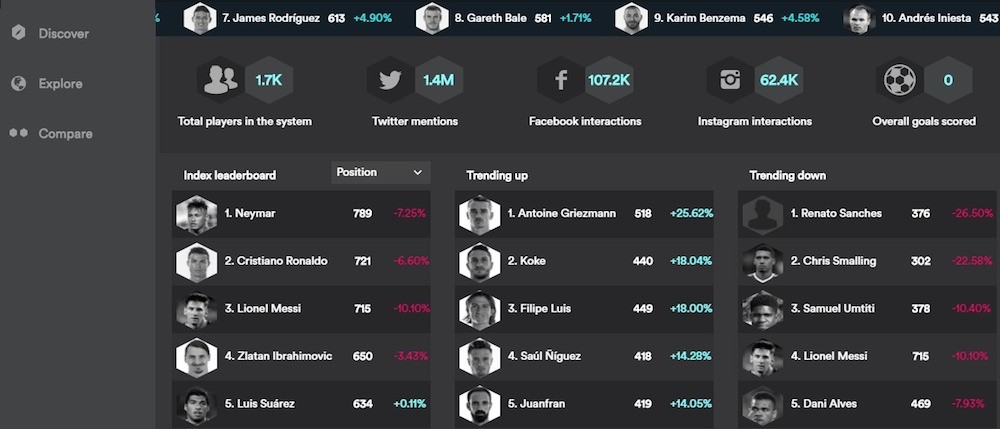
So what does this mean in real terms? Much like the 2015/16 Premier League season, the 2016 Euros has been full of surprises. England was ousted by Iceland in what was thought to be a sure-fire victory, heavyweight Spain was defeated by a widely-derided Italian side, underdogs, such as Wales and Hungary, topped the groups and Northern Ireland shocked everyone by not only qualifying but also getting through the group stages. There has also been an advent of rising stars this year and these players illustrate how to use the latest in indexing to a sponsor’s advantage. Julian Draxler, the 22-year-old German left winger, is a perfect example of this – his social presence has increased by 10% in the past month and the sentiment surrounding him is 89% positive, an overwhelming percentage on the Brandtix Index. Draxler’s appeal is universal too; his most-engaged fan bases are located in Indonesia, England, USA, Germany and Nigeria. By analysing the age, geography and narrative data surrounding Draxler, it’s clear that he is set to be a valuable investment. Smart sponsors will be able to use this data to find athletes like him ahead of the crowd and not only make a great investment but also save themselves a considerable sum.
The fortunes of off-pitch data are set to grow and grow; whilst the offering in football is robust, there are countless other high-value sports which are, as yet, untapped. Tennis and rugby are the most obvious next two. The discrepancy between performance and off-court value has always been an anomaly in tennis – a clear example of this is Anna Kornikova who in her 2002 heyday earned $10m in endorsements without winning a professional singles tournament. Rugby, thanks to the reach of its World Cup and looming Olympic debut, is also set to become a much richer commercial playing field. Prior to their win at last year’s showcase clash, the All Blacks were hailed as the most influential brand in the sport – although the metrics to demonstrate this conclusively varied wildly.

As the whole sports sector becomes more and more dependent on data, expectations about its robustness will become increasingly sophisticated. Fortunately, the world of indexing is well placed to meet it.
Jon Rosenblatt is the CEO of Brandtix, a London-based sports data company. For more information on Brandtix, visit http://brandtix.com/.