




Why US sports teams are lagging well behind the Premier League

Anyone who has worked in sports content in the UK will likely have heard it in a meeting at some point.
“What’s happening in the NFL and NBA? Check what they’re doing, and what we can lift for our channels.”
There is an assumption, perhaps because of their world-leading entertainment culture, that the United States is where it’s at when it comes to marketing: they’re bigger, they’re brasher and, let’s face it, they’re better. Where the US leads, the UK follows.
But does that really check out in 2025?
Should we actually be shouting louder about what our elite clubs are doing on social?
At Little Dot Sport, we examined the Instagram and YouTube output of all 20 current Premier League clubs over the past year, compared to those in the NFL, NBA and the MLB, to understand the landscape in more depth.
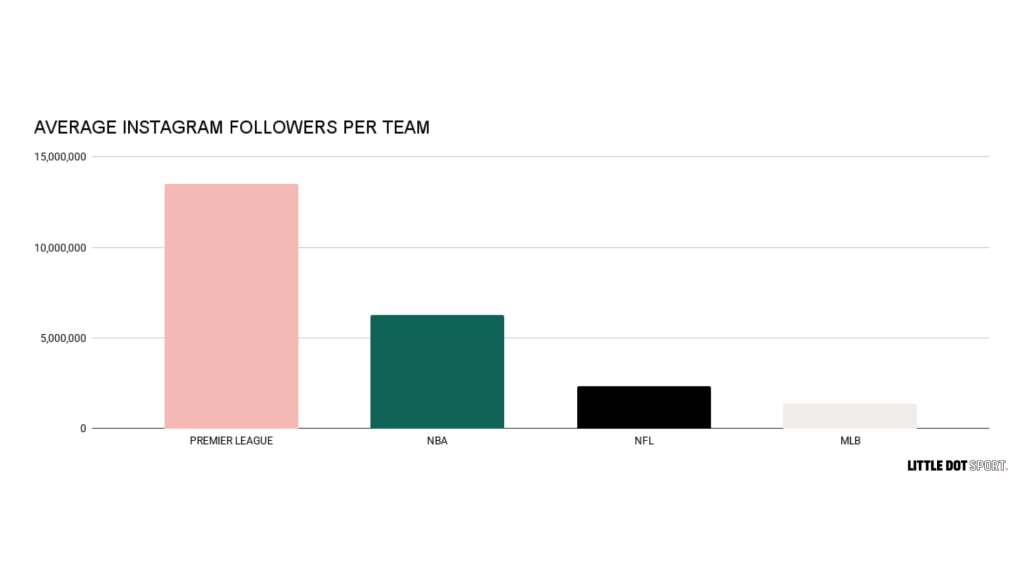
Starting with Instagram, a preferred platform in the US, and the average followership of a Premier League club is 13.5m, dwarfing those of the franchises in the US (see chart below). Not only that, but the gap is growing: over the past 12 months, the median follower growth for a Premier League club is 193k, with NFL back on 113k, NBA on 87k and MLB on 45k.
So what’s behind it?
Firstly, Premier League clubs post considerably more than their counterparts in the States – averaging 47 posts per week, compared to 27.5 for the NBA, 23 for the NFL and just 11.7 for the MLB. This despite the MLB having 162 games per team in the regular season, and the NBA’s franchises playing 82 times before the play-offs. In comparison, Premier League clubs have just 38 league matches, with the most successful playing at most 65 times per season.
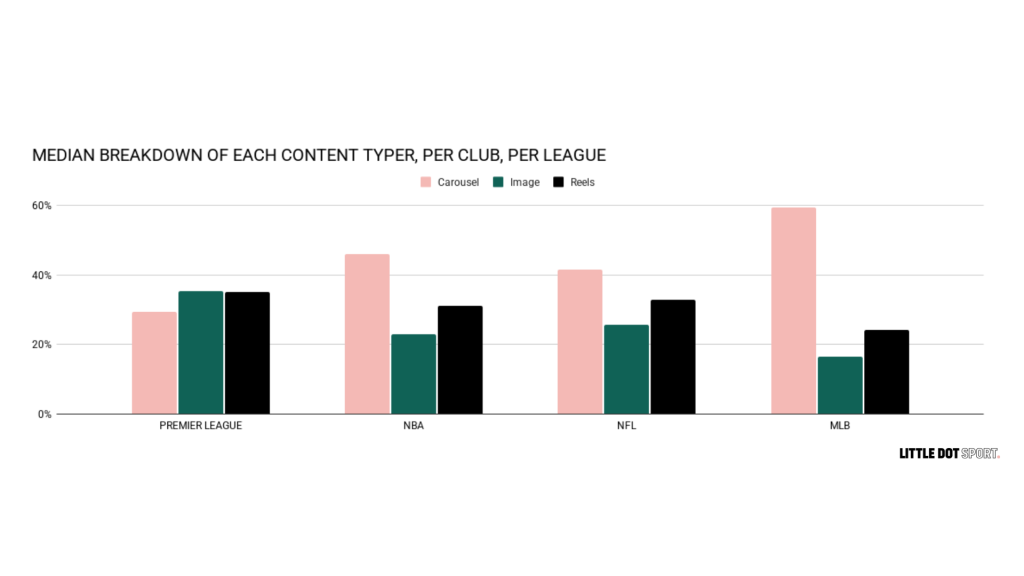
Not only that but the US teams go HARD on carousels at the expense of Reels. There’s nothing necessarily wrong with that, as carousels are key engagement drivers, but if it’s reach you’re after – as most sports entities are as they compete for new audiences – then video should be a priority. In comparison, Premier League clubs have a more balanced output – an approach that appears to be paying dividends.
When it comes to YouTube, we should say straight off the bat that the franchise model and a fragmented rights distribution landscape seems to hamper US teams’ ability to compete. With revenues shared equally with the league and each competing team in some US leagues, for example, there is less incentive for teams to invest in such a resource-heavy platform to grow and monetise their audience.
In addition, match rights are sold much wider in the States than they are in the UK, and with so much competition – including from the league itself – viewership is inevitably distilled.
In contrast, Premier League clubs collect what they earn from YouTube and with match rights more protected on this side of the Atlantic, they post more and have less competition for eyeballs, resulting in a huge differential in viewership.
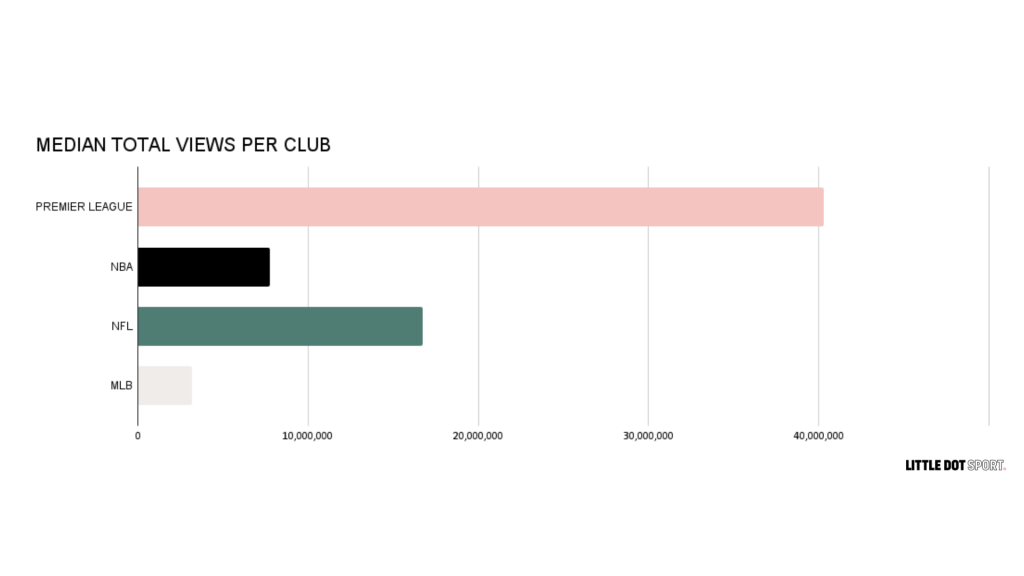
The Golden State Warriors, for example, achieved 66m views over the past 12 months – more than double that of the next best in the NBA, the LA Lakers, and yet this would place them just 10th in the Premier League. The Lakers, a world-renowned brand and the home of one of the most famous sports stars on the planet in LeBron James, achieved 30m views: 3x fewer than Brighton & Hove Albion (90.4m), and 8m fewer than West Ham United.
So what does all of this mean and what can the US franchises do to close the gap?
In truth it will require a drastic strategic shift on Instagram, where they should start publishing more (many clubs in the MLB, for example, barely post during the off season), and redirect resource towards Reels creation at the expense of carousels. But it is also imperative to dig deeper into the analytics to really understand what their target audiences are engaging most with – data is king when it comes to improving social performance.
On YouTube, the situation is more complex due to rights arrangements and the franchise model. The platform is a behemoth and dominates the social landscape as Gen Z spend more time on it than any streaming service, including the likes of Netflix, Amazon and Hulu – so getting your strategy right is critical for engaging the next generation. It is a significant hurdle to overcome, but one the most forward-looking franchises would be well-advised to address to get ahead of the game and close the gap on their UK counterparts.
For Premier League clubs, there is no room for complacency. The social space is increasingly fragmented as they fight for attention with rival teams, the league itself, their players and a new wave of talented platform-native creators who are starting to acquire rights of their own. The grind never stops.
Subscribe to the Sport Industry Daily for regular updates on the biggest stories and latest news in the sport industry.