







CAA Report: Exploring the intersection of football fandom and content

Alex Goddard, CAA Brand Consulting Head of Data & Analytics
Researching the behaviours of football fans is a fascinating exercise. So much so, that our Data and Analytics Team at CAA Brand Consulting recently embarked on a proprietary research study, which set out to better understand where and how fans are consuming football content, and what their motivations are for doing so.
Specifically, we wanted to draw out fresh insights on fan relationships towards emerging formats, such as podcasts, versus more traditional channels and how this differs across age, gender and nationality.
In examining fan behaviours towards football and its associated content, we uncovered numerous cultural complexities mirrored in society at large.
For example, we note the contrasting attitudes of different generations towards digital and traditional media, as well as a shift from the male-dominated, performance-led culture towards a more diverse and enriched expression of human potential. We also see how tech is facilitating greater access and more choice, in turn diluting the influence of established power centres, but also the enduring influence of tradition and nostalgic celebrations of historical moments.
Football is a cultural juggernaut, neither homogenous nor linear, and one of its biggest appeals is that it is for everyone.
No other sport can claim such a broad fanbase, from within which we encounter various subgroups who are looking to connect with football according to their unique characteristics and needs. Aided by the acceleration of technology, it is this varied set of motivations that is fostering such a multifaceted content landscape and its associated consumption behaviours. An example of this, is how female fans are more likely to be engaged with players through their personalities and backstories, something that the FA have successfully promoted for the Lionesses. Whilst players are important for male fans, we notice that they want to appear informed and knowledgeable and will seek analytical content about strategy and tactics.

Despite these differences, what unifies football fans is their appetite for stories. Whilst support for a team still dictates much of how fans spend their time, they are increasingly engaged in the happenings beyond their team affiliations, whether that be global stars, foreign leagues, or the business of football. Fans are increasingly drawn to events away from the pitch, with 40% saying they follow players lives away from football and nearly a quarter saying they have increased the time doing so in the last couple of years.
One format that has capitalised on the increasing demand for ancillary stories is the serialised documentaries flooding streaming services, which craft season-long narratives that deliver a compelling, and real dose of human drama. This appetite for longer form content has been evident in the emergence of podcasts which provide fans with a plethora of engrossing stories that have found a home amongst discerning millennial fans. Younger fans have long embraced the way that EA Sports have entwined players’ real-life performance and personality into innovative gaming formats, engendering the player experience with a sense of reality within the virtual environment.
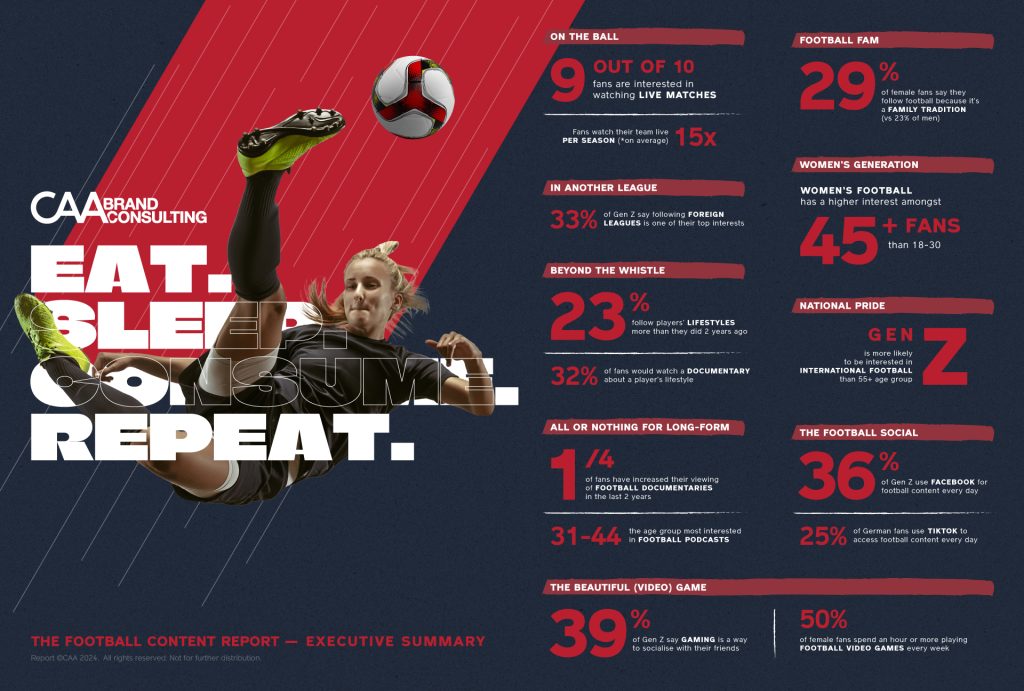
In many ways, football is like the ultimate TV reality show, emanating relentless waves of undulating narratives which are published, curated, debated, memed and marketed, in real time. The sense of urgency this creates keeps fans continually connected, so much so that we must measure their time spent not in monthly or weekly usage, but in hours daily. Yes, live matches remain crucial appointment viewing, but in the interim, fans are continuously watching highlights, their commutes and workouts are fuelled by podcasts and they’re connecting with friends through video games, gossip and banter. All the while spending hours scrolling through multiple social platforms. These highly engaged fans can laugh, cry, be shocked or inspired at any given moment throughout the day.
What of the direction of travel? Given the complexities of the subject, are we able to predict how things will evolve? Whilst media trades in shiny new things, mainstream adoption moves much slower. Generative AI tools and machine learning are certainly speeding up the creation and distribution of content, but are potentially fraught with licensing issues, whilst the metaverse is still very much under construction. Technology only tells one side of the story, and we must return to the fans to get a sense of where things are going. Looking at the younger fan groups we see that football plays an integral role in their friendships, whilst older fans cite football’s important role in society as a key reason for their involvement. In an increasingly isolated world, football provides us with common ground and social currency that invigorates and inspires better relationships.
Stay up to date with the world of sports business by subscribing to the Sport Industry Daily.