




Opinion: The Evolution Of Live Social Video
In January, digital football media brand, Goal, launched Studs Up, a show broadcast on Facebook Live with TV-quality production and talent. Four months on, the brand’s global editor-in-chief, James Marley, explains how live social media has changed since the team’s early work with Facebook Live…
Studs Up is part of Goal’s evolution of live video, which has seen us move from selfie sticks outside stadiums to a full TV-quality production. Although Studs Up is where we are now, it’s been made possible by what we learned from live video over the last 18 months.
In August 2015, Goal’s correspondents were amongst the very first sharing live video through Facebook Mentions. At the time our correspondents were filming themselves outside stadiums taking questions from fans and doing snap match reports from the press box whilst bemused journalists looked on. These broadcasts increased in frequency during the European Championship, with fans enjoying the ability to see what was going on in France at that exact moment. At the same time we noticed that, while engagement levels for Facebook video was high, the two-way nature of Facebook Live engagements was more valuable to Goal as a brand and to our fans.
Being global meant that our live videos were able to put our fans right in the moment almost anywhere in the world, whether it was a training session in Paris or a parade in Argentina. During the European Championship this was taken to the extreme when one of our correspondents broadcasted live from the battles between Russia and England fans. Recorded video can have a similar effect, but it isn’t happening right here, right now and that brings added engagement.
We weren’t alone in seeing the value in Facebook Live. Figures suggest that people spend three times longer watching live video than on demand. Based on this and our own learnings, Goal now publishes at least one Facebook Live a day from offices and correspondents around the world, whether that’s from training sessions, interviews, post-match reports or direct from the news desks.
Live videos also allow our fans to get involved, whether that’s asking questions to players and managers (like we’ve done with the likes of Carlo Ancelotti and Lucas Moura) or quizzing our correspondents about transfer news. Much like with live TV, live broadcasts feel more personal – it’s akin to the difference between watching a play in a theatre and watching a movie. This combination of being there in the moment, authenticity and unpredictability is what brought us to launch Studs Up, our first TV-style Facebook Live show.
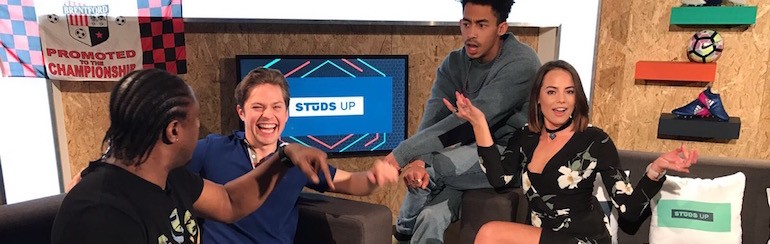
Studs Up is broadcast from Gfinity studios in London, every Thursday at 8pm. We use a multi-camera setup and it mimics the high-production values of linear TV, but crucially, we have the ability to flex up and down in length depending on how viewers interact with particular segments and guest opinion. The multi-camera setup also allows our presenters to move around, giving the show a kind of energy you don’t get from confining the action to two sofas.
While the action on the Studs Up set is live, we’ve combined it with pre-recorded segments, such as skills challenges from FFDTV and Worst of the Week, in which a YouTube football personality presents three characters from that week’s football to be stuck on the Worst of the Week wall. As well as guests from music and sport, each show includes personalities who’ve made their names online, most often on YouTube. This is important, as YouTube is a great training ground for such talent but also because these personalities already have an engaged social media following.

Although half-hour Facebook Live shows are not yet the norm, we expect this to change during 2017, especially with regards to football. Already this year we’ve seen Univision strike a deal to broadcast Liga MX football on the platform while LaLiga became the first European league to stream a match on Facebook. Back in February, Mark Zuckerberg stated that he wants people to think of Facebook when they have the thought “I want to watch video content now”, something that should be helped by Facebook recently launching video apps for streaming boxes and TV sets, and the company’s public request for original programming, including sports and gaming.
Goal is shortlisted for Digital Platform of the Year at the BT Sport Industry Awards 2017. View the Official Shortlist here.