





Opinion: The Organic Source You Should Care About Most
In an era when traffic from social media is increasingly throttled, Daniel Ayers, consulting partner at Seven League, explains why Google should be the organic source you care about the most…
Our research shows the majority of Premier League clubs are not using the tools that would give them greatest visibility on Google, undermining any efforts to realise commercial value from their sites.
This is specifically not just about SEO. It’s about optimising for Google as a platform. In sport, the popular Onebox and Knowledge Panel features provide fans with much of the content they need, but erode traffic that would once have gone to official club and league sites.
HOW BIG A DEAL IS THIS REALLY, THOUGH?
A repeatable insight we see across all websites is illustrated below: the number of times the website has appeared on a Google Search Engine Results Page (SERP), split by device.
22.6m is a big number in anyone’s book. It’s from a 90-day period, so >250k impressions per day from people actively searching for content the official site contains.
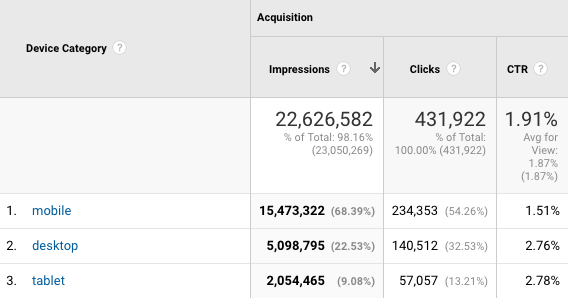
Search Impressions by device on a major football club website
But wow: those click-through rates show a lot of potential traffic not being realised.
Wow 2: mobile search impressions are 3x larger than desktop. This really drives home how important it is that your site is well presented on mobile search.
So, what happens when we start to search for a Premier League football club on mobile?
Let’s try l-i-v-e-r- …oh.
The next match / last result / latest score show up before we’ve finished typing.
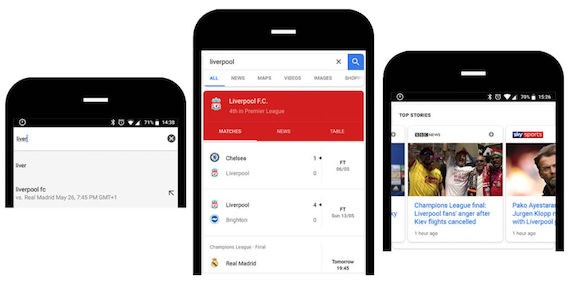
(l-r) fixtures shown in the predictive search dropdown; the Onebox showing all match data; heavy competition for the Top Stories slots
If we complete our search, results, fixtures, standings and news are all an easy tap away. This is the Onebox, it’s powered by Google and provides excellent service to the user but minimal value to the club.
Next is ‘Top Stories’, featuring news articles in AMP format from any relevant publisher. It’s possible for official club sites to rank here but there’s high competition for this space and the majority of content is not club-owned.
Keep going down and we might see organic results but often it’s the Knowledge Panel, Google’s summary of an organisation’s basic details plus playing roster and ‘similar’ brands, i.e. other clubs.
Other content that may appear before your site result includes tweets from the club account, and a carousel of video content from multiple sources.
WHY DOES IT MATTER?
Visitors from organic search are your best customers: they spend the longest time on-site, look at more pages, have some of the best conversion rates and are your top revenue driver.
On the one hand, it looks like visibility for sports club and league websites is being minimised by the Onebox in particular, and that’s a major concern.
As ever though, Google also offer ways to reclaim some space and we focus on 3 primary methods below – Google Posts (editorial), Structured Markup and Accelerated Mobile Pages (technical).
The problem for Premier League clubs is that most don’t take utilise these methods – including commercial giants like Manchester United and Chelsea, where there will be a direct relationship between traffic and the ability to deliver on commercial partnerships.
Both those clubs have new sites in beta which may feature the technical aspects in full build, although they’re not included so far. We do know that Spurs will be including both on their new site.
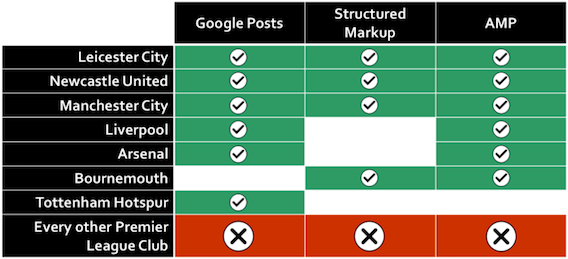
Any club not listed here will be underperforming for search traffic vs their potential
SO, WHAT CAN YOU DO?
1) Get into Google Posts
Posts is a relatively new format from Google – launched in the US in 2016 for Presidential candidates, it was later extended to US brands and Google My Business accounts but is only available by application for brands in Europe.
It allows the publisher to produce small cards in a number of formats – image-led, video-led (YouTube only), events, polls and a new Story option that opens up into full-screen portrait mode.
These cards appear as part of the Knowledge Panel that appears in the right-hand column for desktop search results, and somewhere between 3rd-5th position in mobile results.
Our findings are that Posts definitely add incremental visits to your official site; if used well they will be amongst your top 10 site referrers, and on match days can be in the top 2 when search volumes peak.
2) Use Structured Markup for News Articles
Our screenshot here is of the organic search result for LCFC.com, a site we know very well.
As well as the regular site description and key subsection list, latest news stories are listed in a horizontal, image-led carousel.
This is driven by Structured Markup, additional metadata in the page code telling Google (and other crawlers) that the content is a news article and giving precise detail of the headline, publish date, image url etc.
Google have excellent documentation for all content types that can be marked up in this way (it builds on documentation that’s been available for several years at schema.org, but with specific examples of how the search results page will interpret the data).
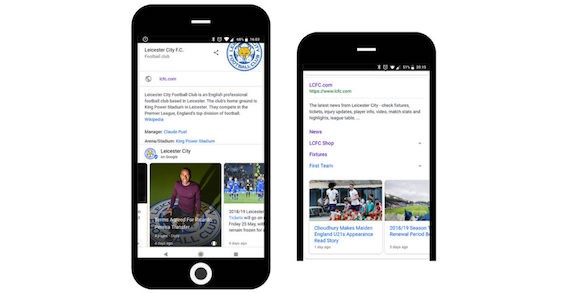
(l-r) Leicester City’s Google Posts content; LCFC.com news articles appearing as a carousel courtesy of Structured Markup
3) Publish in AMP format
We’ve talked about this at length before and it’s still a thing.
Structured markup and AMP can be interchangable; Liverpool just use AMP and they still get the news article carousel in their site’s mobile search result, for example.
We’d advocate having both, though. Structured markup will have multiple future uses including in voice search and Google’s own newsfeed, while AMP is essential to appear in the Top Stories section of the results page.
In reality, most AMP traffic for club sites will come from Twitter rather than Google. The native Twitter app will default to the AMP version of any page linked in a tweet.
IN SUMMARY
We’ve used Premier League club sites as an example because the fact that most of them don’t optimise for Google suggests (a) that not many other sports orgs will be doing it better, and (b) ongoing optimisation of digital products often falls through the cracks if there’s no coherent product strategy that connects it to the overall digital strategy.
Man City employ multiple digital product managers while Liverpool also have significant in-house tech resource.
Leicester, Newcastle and Tottenham are Seven League clients and we’ve performed a role for each over the past 2 seasons that helps provide the glue between content, tech and commercial needs. You can – of course – talk to us about doing the same for you.