





The Big Interview: Harlequins
Ned Wills, commercial director of Premiership Rugby side Harlequins, speaks to Sport Industry Group about prioritising your sponsors and a return to Champions Cup rugby…
Tell us about your role at Harlequins?
I’m the commercial director at Harlequins, part of a senior management team that covers all the commercial side of the club operations and marketing. I’ve been at Quins now for two seasons having previously worked in the charity sector and in financial services, in particular working for UBS running its sponsorship portfolio in Asia Pacific.
Is the commercial landscape for club rugby what you expected when you took on the role two years ago?
There is certainly still a phenomenal opportunity for growth in rugby. We’ve seen the growth of the Rugby World Cup and the inclusion of rugby sevens into the Olympic Games in the last few years, which is fantastic news for television audiences, engagements and rights fees. All bringing more money into the game. It’s all really positive news.
We’ve already got some fantastic partners on board with us who are really engaged and keen to leverage their association and build their partnership. We have just had adidas re-sign for another five years on top of the three year commitment they had before, that’s a phenomenal endorsement of adidas’ approach to club rugby, the sport, and us as a club. They have pulled out of a number of team sponsorships in recent years, so to maintain Harlequins amongst their rugby portfolio that includes the likes of the All Blacks is fantastic for us. No other Premiership club has a brand like adidas on board.
Elsewhere, we have a very strong pipeline of conversations that are taking place with a whole range of different companies as we look to build for next season, and we are always looking at ways of building those partnerships. Rugby is in a really interesting place at the moment and there is still a lot of growth to come. We are really positive about what the future holds.
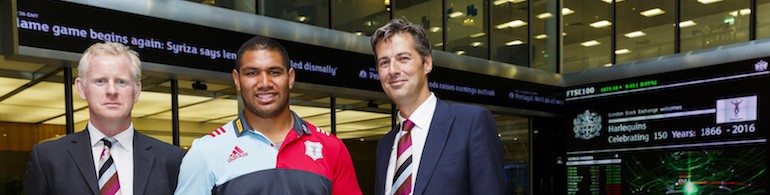
(Ned Wills pictured above right alongside commercial operations director Jim Eyre and Quins’ forward Mat Luamanu)
As well as adidas, there’s also the likes of DHL, IG, Maximuscle, and a number of national brands working with the club at the moment – what is it about Quins specifically that attracts so many brands compared to some other Premiership clubs?
Quins, as a brand, is as historic as they come. We are 150 years old this year. We’re also a London club with a quintessential London focus for our businesses, so that is certainly an attraction to our partners as well. For the likes of IG for instance south east England and London is a core focus for their clients and potential clients.
I think the way we go about our business is crucial as well. The culture of our business has always been to bring an innovative, open and pioneering style to everything we do. We are constantly looking at what our next innovation might be, and what’s the next thing that we can do to take rugby to the next level. We like to encourage our sponsors to try new things too, and our playing style is reflected in the way we run our business – and it’s been really successful for us. Our challenge with our partners is to constantly ask ourselves, ‘how do we build on our partnership, and how do we align that partnership with the bottom line of those businesses – how are we helping them to generate revenue?’
It may be that we are not directly impacting their sales but having an understanding within the partnerships of how we can impact a path that could lead to a direct sale is a really important thing to do. Our ability to open up that dialogue from the outset to establish those objectives and what is considered a success for the partnerships is ultimately how that leads to business success for us.
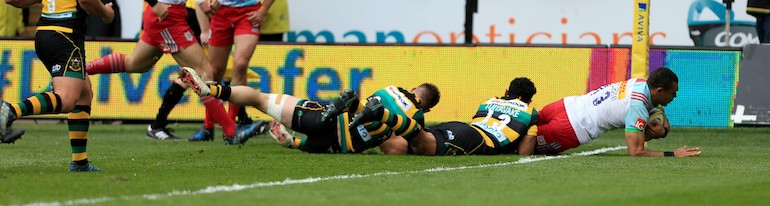
Congratulations on getting into Europe once again after just missing out last year. When it comes to the Premiership and Champions Cup qualification, is it financially essential for the club, or is it simply about the prestige and success that comes with it?
Directly, no, it’s not essential in perhaps the way that it is in football. In terms of the league payments, we won’t immediately get a significantly bigger windfall if we’re one side of the qualification mark or the other. That said, it’s incredibly important for so many reasons when it comes to our other revenue streams that we are reliant on – such as our fans and partners. This year would have been the third season in the Challenge Cup, which is not where we want to be.
There are of course the direct, knock on elements as well, for instance it’s obviously much easier to sell a full stadium to a fixture against some of the biggest clubs in Europe than it is to a fixture against a team from Romania. Inevitably, top flight rugby will result in more tickets and more happy sponsors who are going to get more activation and value from their partnership, which means we hit our targets, which means stronger overall brand development. So everyone’s happy!