





NFL: The Dream Becoming A Reality For Louis Rees-Zammit and UK Athletes
News of Louis Rees-Zammit signing with the Kansas City Chiefs sent shockwaves rippling across the Atlantic, when the former Wales rugby star joined forces with the reigning Super Bowl champions.
In that moment – as the 23-year-old put pen to paper on the thee-year contract that ratified his transition from elite rugby union to the National Football League – his dream became reality.
Next season, the boy from Penarth will take to the field with legendary quarterback Patrick Mahomes and superstar tight end Travis Kelce, if he makes the team’s final roster for 2024.
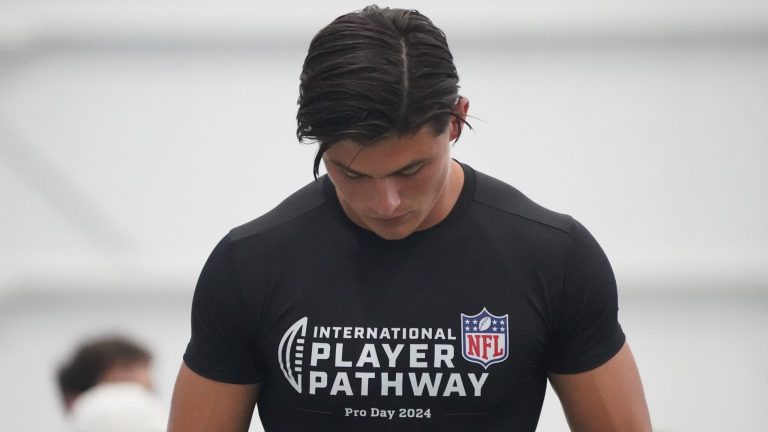
“I think he has as good a chance as anybody to make it,” Osi Umenyiora, co-founder of the NFL’s International Player Pathway (IPP), tells Sport Industry Group.
The IPP serves as a bridge for international athletes aspiring to make the switch to the NFL. Its growing appeal is such that the former 32-capped Wales international announced in January that he would be foregoing selection for the country’s 2024 Six Nations campaign in order to join the programme.

“We know he’s a fantastic athlete. Really fast, or ‘rapid’ as they say out here,” adds London-born Umenyiora, who won two Super Bowl championships with the New York Giants.
Before touching down in Kansas City, the rather appropriately nicknamed ‘Rees Lightning’ ran an impressive 4.43 second 40-yard dash time, catching the attention of numerous NFL scouts.
“He has all the tools, a good head on his shoulders, we think he’s gonna be a fantastic asset for a team once he learns the game,” he continues.
While conceding that switching codes will not initially be easy for the young Welshman, Umenyiora believes, “Over time, and with a little bit of refinance, he has the ability to be a great football player.”
The “genesis” of the IPP
After hanging up his cleats in 2015, it was during a visit to his hometown of London that Umenyiora came to a realisation; that the NFL would need more international players if it truly wanted to expand globally.
“You start having an affinity for the game by following heroes,” he explains. “So it occurred to me that as the NFL is trying to expand internationally, we need to have more international players in the league, because that would be a way to actually grow the game.”
His discussions in 2017 with Aden Durde, the British NFL coach who now serves as the defensive coordinator for the Seattle Seahawks, are what he hails as the “genesis” of the IPP.

Another member of the IPP’s class of 2024, 22-year-old Irish kicker Clarlie Smyth, joined the New Orleans Saints that month, an early beneficiary of the programme’s expansion this year to include specialist positions.
The remainder of the 2024 cohort – which includes English prospects George Smith, Travis Clayton and Harry Mallinder – will be hoping to follow in Rees-Zammit and Smyth’s footsteps this month, either during or after the 2024 NFL Draft, which takes place between the 25th and 27th April.
Indeed, athletes from all over the world dream of making it to the NFL, and given the league’s global reach, it’s hardly difficult to see why.
“You have people in so many different countries who are able to watch the NFL. But If you wanted to play the game in the NFL or play big-time college football, you had absolutely no recourse.“
Osi Umenyiora, Co-Founder, NFL International Player Pathway
This year’s Super Bowl between the Chiefs and San Francisco 49ers garnered a record audience of 3.4 million total viewers in the UK, and was watched by 62.5 million people globally.
Thanks to the IPP, the NFL is now more accessible than ever for bidding international players. But Umenyiora recounts the days where the path to the field from overseas was not so simple.
“Ultimately you have people in so many different countries who are able to watch the NFL. But If you wanted to play the game in the NFL or play big-time college football, you had absolutely no recourse.
“There was nothing for you. There was no way you could do it. This programme actually gives these people the ability to come in.”
Outlining his vision for the sport, he continues, “It’s not just an American game, it’s a global sport. And we’ll give you the opportunity to play the game.”

NFL UK’s “pyramid strategy”
NFL UK General Manager, Henry Hodgson, also reflects on Rees-Zammit’s decision to enter the programme.
“To get someone of his calibre, with the world at his feet in rugby, to come and do this does speak to the growth of the NFL as a whole,” he says.
“Louis’ pathway to the International Player Programme was him making that leap. We didn’t go out and pursue him, we weren’t chasing his signature.
“He came to us and said – ‘This is something that I want to do, I’m passion about the sport, I love the sport, and as an athlete I back myself that I can be successful in it, if I can be a part of this programme.’”
As Hodgson outlines, the IPP forms one of three pillars of the NFL’s strategy to grow the game in the UK, along with flag football and the NFL Academy.
“To understand that they could then potentially represent their country in the Olympics is pretty exciting. And I think having that where it hasn’t been in the past is a massive difference maker.”
Henry Hodgson, General Manager, NFL UK
“There’s a pyramid if you like of pathways hopefully to create some British NFL athletes,” he explains.
“It starts obviously with flag football. It’s the non-contact version of the sport, the easiest way for young people perhaps to get the chance to experience the game.”
Speaking to Sport Industry Group at the UK NFL Girls Flag league season launch event in March, Hodgson stresses the importance of flag football as an avenue through which young people are introduced to American football.

“I think what’s most exciting about that element is I you’ve got this sort of level playing field of girls and boys who are discovering the sport at the same time, playing together. In this case today, [there’s] an all-girls league which is unique in itself,” he says.
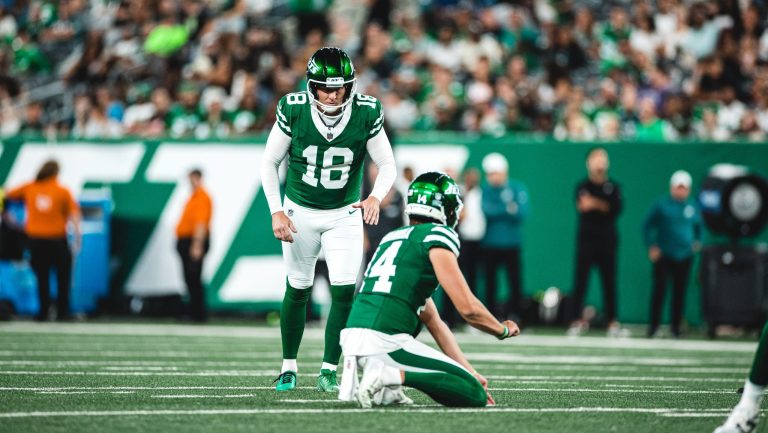
In 2023, the Chicago Bears and New York Jets teamed up to launch the UK-based flag football league for girls aged between 12-14. Just one year on from its launch, the league recently saw participation more than double for its second season, increasing from 120 up to 260 girls.
In the buildup to the Los Angeles 2028 Olympics, where flag football will be included for the first time, Hodgson reflects on the unique opportunity for young girls and boys to represent their country at the games.
“They’re going out on the field now, this’ll be the first time for a lot of them that they’ve ever experienced this game. But to understand that they could then potentially represent their country in the Olympics is pretty exciting. And I think having that where it hasn’t been in the past is a massive difference maker.”
Naturally, the launch of the NFL’s Global Markets programme in 2021 has presented new opportunities for franchises to grow and cultivate fanbases in markets outside of the US.
Through this programme, six clubs currently hold UK-wide marketing rights. These include the aforementioned Jets and Bears, as well as the Jacksonville Jaguars, San Francisco 49ers, Minnesota Vikings, and Miami Dolphins.
Hodgson says that for some of these franchises, the growth of grassroots flag football is central to their UK strategies.
“We work really closely with all those teams,” he reveals. “I think what’s interesting is that all six or seven clubs have a very different approach to how they want to grow their brands in this market,” he tells Sport Industry Group.
“Some of them are saying ‘flag football is right at the heart of it.’
“Some of the clubs think that giving kids a chance to experience their brand, experience football is going to be the best way to grow it. And most notably here with the Jets and Bears making that decision to launch an all-girls league which is in itself a unique thing that we hadn’t done in the UK.”

The Next Generation
In 2019, the UK took a significant step closer to growing its own NFL athletes, when the league opened the UK’s first-of-a-kind NFL Academy.
Since first opening its doors, the Academy has helped more than 40 athletes aged 16-19 earn football scholarships to play in the NCAA.
Lamonte Winston heads up the Academy, bringing his four decades of coaching experience, including lengthy spells with the Chiefs and Oakland (now Las Vegas) Raiders to its campus in Loughborough.
Having previously worked with some of the biggest stars in the sport, such as four-time Super Bowl champion Joe Montana, and Hall of Fame tight end Tony Gonzalez, Winston reflects on his first year as Head of the Academy, which currently comprises 63 students from 14 different countries.
“Our guys – they appreciate just the fact that they can dream about maybe going to America and playing football. They don’t take that for granted.”
“Our goal is to get these kids coached up, get them educated to where they become degree-seeking student athletes in America, and can compete for full scholarships. So, in that regard, we’ve hit the ground running,” says Winston.
The Academy’s core objectives are not only to develop players to then ship out to various college campuses across the US, but also to provide a strong educational foundation for life as a college athlete.
Winston explains why this is of paramount importance. “You’re going to be a student athlete if you’re gonna be in the Academy. It’s not the other way around. If you will not go to school and excel, you will not play, that simple.
“We teach them how to compete on both playing fields – classroom, and on the field,” he affirms.
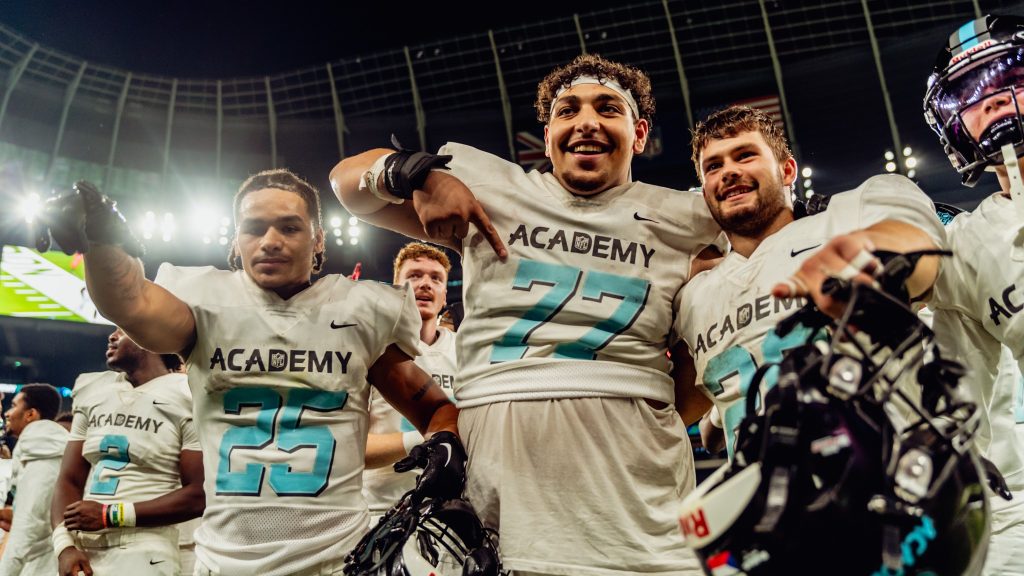
Some of the Academy’s recent success stories include Daniel Akinkunmi, who committed to Division One powerhouse the University of Oklahoma in October, and Timi Oke, who will play at Northwestern University from next season. Last year, Emmanuel Okoye played his first season at the University of Tennessee, while Peter Clark suited up for Temple University.
With new infrastructures in place, the UK seems better equipped than ever to develop its own homegrown NFL stars. But despite the evident progress that the Academy has made in its first five years of existence, Winston believes we should temper our expectations for the immediate future.
“We need to all just slow down,” he states.
“Let’s get some guys to Division One, which we have. Let’s get them starting like Peter Clarke is. When guys start, and have a significant amount of time, and have production, now scouts are looking at them.
“Then you can get approval from area scouts like I was with the Chiefs for many years. You get in the mix with all these other prospects from all the other schools, winning some games, making some pathways.
“Then you put yourself in position to one day get your name called.”
As Rees-Zammit prepares to step onto the field at Arrowhead Stadium, it seems that the young Welshman is paving the way for young athletes to take a once unfamiliar path – from the zenith of British sport – to the utopia of the National Football League.
Stay up to date with the world of sports business by subscribing to the Sport Industry Daily.