



The Big Interview: Kate Richardson-walsh
After becoming an Olympic champion at Rio 2016, England and Great Britain’s long-serving hockey captain Kate Walsh-Richardson retired from international sport at the top. Now backing Women’s Sport Week, we asked the hockey star what needs to change, and the importance of trusted leaders, on and off the pitch…
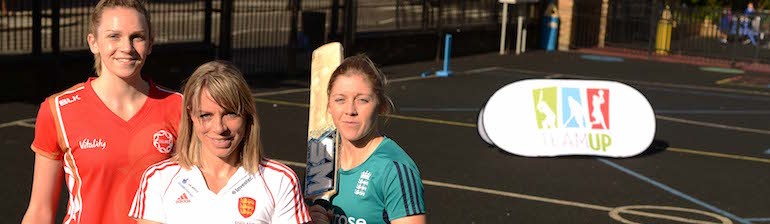
You’re supporting Women’s Sport Week through the launch of TeamUp, a new campaign to build the fanbase for women’s team sports. How important is fanbase growth to your sport, and what needs to change?
TeamUp is a great initiative that sees the governing bodies of hockey, netball and cricket come together to make some real change in grass roots participation. The three sports have World Cups on home soil over the next few years, starting with the Cricket World Cup in 2017, followed by hockey in 2018 and netball in 2019. Collectively the three governing bodies are aiming to get 150,000 more girls between the ages of 7-13 playing a team sport, with around 6,000 teachers getting training and support from the Youth Sport Trust. It’s important for young girls to be able to see the elite athletes playing and competing on home soil so they can be inspired. We want as big and diverse a fan base as possible and for sport to be accessible and available to all.
You were captain of the England and GB women’s hockey teams for 13 years. From your experience there, and from observing the male hockey teams, do you think female teams are motivated in different ways to male teams, and do you think the team ethos in a female squad is different to that of a male squad?
I’m intrigued by the differences between male and female teams. Having only worked in and with female teams I would say that women like information, authenticity and clarity of communication. This is a broad statement though as all people are different and will respond and react to things in different ways. I think there are golden threads that run throughout all teams regardless of gender. For example having a clear vision, an agreed set of behaviours and strong leadership models are fundamental foundation for any team.
How does hockey compare with other team sports in terms of equality between the male and female games?
In many ways there is parity between the genders in hockey, particularly at grass roots level. Hockey is very fortunate to receive UK Sport Athlete Personal Awards from the National Lottery and this is equal across the male and female programmes. The women’s senior team have Investec as a grass roots sponsor which has really helped elevate the profile. I would say however that it’s important to note that the top male players in the world can earn far more in their hockey careers. The top male players readily achieve five figure salaries in domestic hockey – a handful of women can achieve the same. Male players have the opportunity to play in a Hockey India League which again sees all players receive tens of thousands of pounds every year. There is no equivalent for women. There is also a European Hockey League which is live streamed world wide and has prize money attached. The women’s European competition is a poor relative. We are still stuck in a catch 22 cycle, without the coverage we don’t attract sponsors and without the sponsors we don’t attract the coverage. I hope this will change and we can move the sport forwards together.
Your final against Holland was watched by over 9 million people on prime time Friday night BBC TV- have you noticed any significant impact at grassroots level, or commercially, since the Games? And what do you think hockey should do to sustain this interest?
I couldn’t believe it when I heard how many people tuned in to support the GB women’s team in their quest for gold! It’s a phenomenal stat but most importantly shows that there is a huge appetite to watch top level women’s hockey. We must capture this momentum and continue to develop hockey in this country. Gold medal winning players went all over the country following the games to inspire those already playing, welcome returning players and encourage people into the game for the first time. We have seen a massive influx of participation at club level already. For me I feel we need more change.
We need to attract more corporate sponsors into the sport and in order to do that we need a domestic package that is worthy of television coverage and we need to change this quickly. The governing body have worked tirelessly to get international tournaments held every year in the UK to gain momentum around the international game which is hugely important. Taking hockey around the country in a fun, vibrant and exciting format at club level is the next step.
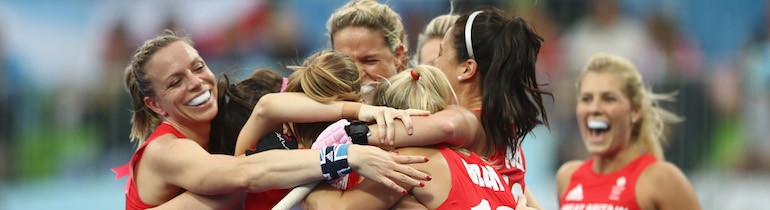
The GB women’s team have gone from 11th at the World Cup in 2014 to undisputed world beaters in 2016, what do you think caused such a dramatic turnaround in fortune?
I think the devastation that the England squad went through in 2014, finishing 11th out of 12 at the World Cup was the catalyst required for change. The culture that we had worked so hard on in the London cycle had shifted and it wasn’t a good fit for this particular group of players. Once we established where we wanted to go and what we wanted to be about on a daily basis as a group things changed in a positive way very quickly.
When you know very clearly what you need to deliver as an individual for the good of the team and what to challenge yourself against you can create an environment that fosters development and growth at every level. To support this we ensured there were lots of opportunity to talk and listen to each other whether it be one on one, small ‘buddy’ groups, playing lines or full squad meetings. This created a strong ownership and sense of responsibility for the programme.
You were one of several key female leaders on the pitch at Rio 2016, but women are still significantly underrepresented in senior leadership roles off the pitch, while women’s sport is still missing out in many areas of the media and sponsorship budgets. Is that a concern to you, and what needs to change?
The underrepresentation of women in leadership positions in sport generally is a huge concern. I think we have made great strides but we must do more and question more. I think this is an issue that should be on everybody’s radar. As women, what can we do to improve our confidence levels and put ourselves forward for leadership roles we perhaps think may be out of our reach? I truly believe we need to see it to be it.
Subconsciously you don’t think it’s an option to be a head coach of a men’s hockey programme because there is no woman doing that. Why not? Once we break down some of these barriers I think we will see great change but I do believe it will take time.
Having married your teammate Helen in 2013 you also made headlines as the first same-sex married couple ever to win an Olympic medal playing for the same team. How was your relationship received by your team mates, and are you conscious of needing to be a role model to help change attitudes within sport?
The focus on our relationship seems a bit strange to us at times because for us it’s just our normal lives! However, we do understand that we are very fortunate to work in a sport that is open and supportive of gay relationships. We also have exceptionally supportive family, friends and teammates who want us to be happy and true to ourselves. We know that this isn’t the case for a lot of LGBT people. The squad and management understand that at work we are professional and separate people and at home we’re a couple. We want people to feel free to talk about their sexuality, to feel like they can find a space in the world where they can truly be themselves. For us that space has been hockey.
What’s next for you now that you have retired from international hockey?
I’m looking forward to new challenges ahead both in and out of hockey. Within hockey I’d like to continue to play domestically in the Netherlands and develop my coaching skills. I’m also very much looking forward to working with private companies, exploring and developing teamwork and leadership skills. Outside of hockey I’m very passionate about sport generally and am working with Access Sport, a charity that uses sport in local communities, making it accessible to all and helping disadvantaged and disabled young people achieve their potential. Now I’ve hung up my international hockey stick I also finally have more time to enjoy the things I love, such as fashion, travel, Manchester United and cooking!