





The Big Interview: Judy Murray
Judy Murray talks to Sport Industry Group about her variety of training programmes to promote growth across tennis, creating her own foundation, and why tennis needs more female trainers…
What have you been up to since leaving your role as Fed Cup captain in 2016?
Back to my roots! I have gone back into working entirely at a grassroots level, as I knew I could have much more long-term impact on the growth of tennis by getting out into the field and sharing my experiences. Mainly you’ll find me running programmes that build a bigger and stronger work focus across the UK.
In Scotland I have a programme called ‘Tennis on the Road’ which is more or less a van full of sports equipment. Myself and another coach do 50 days a year and go to places where you wouldn’t normally expect to find tennis, in disadvantaged or rural areas where we build work forces within the local community. We show teachers, parents, students, coaches how to deliver starter tennis to kids, teams and adults in whatever space they have available, whether that is a school or a hall or playground, or a tennis court of course.
The other thing is the ‘She Rallies programme’ which I created with the LTA, targeting more women to get into coaching. Probably 15% of our coaching workforce across the UK in tennis are women and we have lost 30% of the women and girls playing tennis since 2005. When those stats came out they were a big shock to the LTA.
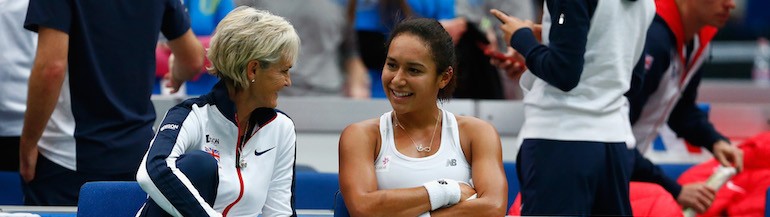
Judy Murray working with Britain’s Heather Watson during her time as Fed Cup captain in 2015.
The programme works around a number of part-time ambassadors across the whole of the country. I trained the ambassadors up to deliver specific workshops, and then they go out into their areas and deliver to other women. They could be teachers, mums, students, club members, assistant at schools, or youth leaders – basically any women that want to get involved in either coaching or in running fun days or competitions for girls. We want to build a bigger, stronger work force in the UK through these ambassadors, in order to get more women and girls playing and staying in tennis.
We started with 26 ambassadors in February last year and in December we added another 30. We have 56 part-time ambassadors creating female focussed activities in tennis across the country.
So we basically need more Judy Murrays?!
Oh I don’t know about that! But the facilities on their own won’t get the job done.
In a sport like tennis you need someone to play with, it is not a sport you can go out and just play on your own like you can with golf or something like that. Plus, so many girls love being with their friends, so the bigger the group activity and the more fun and stimulating the activity, the more chance we have of making our sport more attractive to girls for the long-term.
For me the numbers are absolutely crucial. If you can start with a big number of girls of the same age, at the same time, then you have far more chance of keeping them in that activity as they will create a social group and grow into the sport together. If that social group starts to drift away, others drop out because their friends aren’t doing it. The numbers are so important and having all-girl activity as an option has to be a way forward as so much research will tell you that in any physical activity girls are often intimidated by boys, as boys are generally noisier, more physical and more competitive from a young age. This makes the girls not enjoy the activity, but it is not the sport itself they don’t enjoy, it is the environment. We need to create more girl friendly environments to keep girls in our sport.
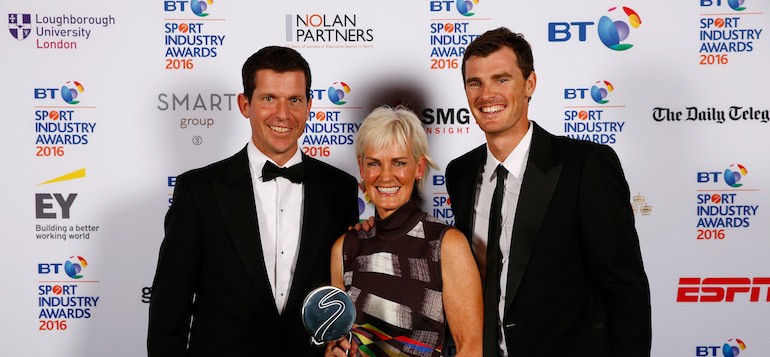
Judy Murray collects the Outstanding Contribution to Sport Award, alongside her son Jamie, presented to the Murray family for their efforts across tennis at the BT Sport Industry Awards 2016.
You mentioned the concerning drop-out numbers from 2005, have you noticed a difference in that time in your experience?
Yes certainly, the number of people that have been influenced by the ambassadors we have been working with has been very encouraging. We can definitely see a difference. There have been so many mums telling us that the all-girl option is exactly what we need as there are so many stories about girls dropping out because of the boys.
There were mistakes made a few years ago because the number of girls competing at the under 10 age group was so small, many girl’s competitions were being cancelled because there weren’t enough numbers to justify the cost of running the event. The LTA decided to put the girls with the boys in mixed competition at under 10 and that really put some many young girls off competing.
In a team sport, even if you are a little shy or self-conscious, you are part of a big group. In a sport like tennis, an individual sport, you are there on your own. It’s tough. We need more doubles events and more team competitions. There are a lot of things that we need to look at in our sport to make it more inclusive and to make it an environment where girls can thrive.
On a wider scale, do you think sport can play a role in creating an equal playing field for women in society – not just the sport courts – and where do you think sport’s role is in that conversation?
I think sport can teach you so many lessons and life skills: communication, organisation, discipline, leaderships, dealing with adversity, teamwork…there are so many life skills that can be developed through sport. I certainly learnt so many skills from both tennis and badminton within my community to nationally when I was growing up.
When I was growing up it definitely gave me confidence, feeling part of something, belonging to something. Sport plays a massive part in all these areas as well as the benefits of being active and leading a healthier life style. All sports are competing with so many other things for a kid’s attention. Sport has a huge role to play and I would love to see the government getting more behind sport in schools.
I have always believed that being physically literate is just as important as being numerically or alphabetically literate in terms of the life ahead of you.
The thing with school is that the kids are there already, the facilities are there, they have pupils and teachers to bring in specialist sports people – be it within the curriculum, after school hours, or at the weekend. I also think that school sports facilities should be open to the wider community in the evenings, weekends and holidays.
There is so much more that we could get out of schools. Two hours of physical education a week is just not enough. It needs to be seen as being so much more important in the overall development of a young person’s life. Schools and parents have a big role to play to get kids to enjoy exercise, sports and competition from a young age.
What’s next?
I have just launched my foundation, The Judy Murray Foundation, focused on taking tennis into the deprived and rural places in Scotland. Identifying a number of projects each year and building the communities, and running events to stimulate interest. The key is investing in people who can keep tennis in good shape in those areas for the long term.
I should have a base to work out of by 2020, just outside of Dunblane. It’s a multi-sports complex that will have tennis at the heart of it, as well as activity parks, six hole golf course. It will be everything that I enjoyed as a young player and as a young mum at a local club. It’s about growing a love of sport and developing a sense of community and seeing that if you bring people together, and you get them working together, before you know it you have an army…and an army can have a big impact!
This year, as part of the She Rallies programme, the first thing that I did to launch it was to set up a woman only conference just for female tennis coaches, with seven female speakers, and it was the first time any sport had done anything like that.
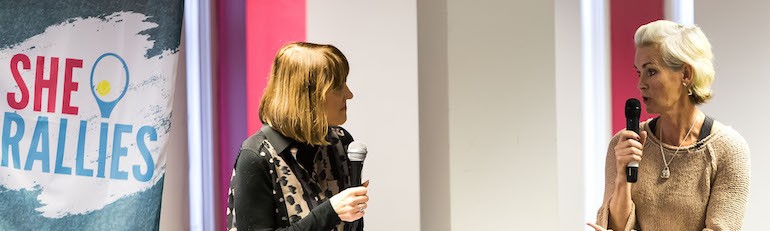
Judy Murray answers questions during a Q&A at last year’s She Rallies Women’s Coach Conference
The buzz in the room and the relaxed atmosphere and the networking was just what women need. My experiences have always told me that when you bring women together you don’t get egos and you find much more willingness to network and share. It was the first time any sports had done that – just female coaches and female speakers. It’s great to see sports like cricket doing that too.

Judy Murray will be the opening speaker at Women in Sport’s Empower Conference on 18th October, at The Museum of London. Find out more: empowercon18.eventbrite.co.uk