






Opinion: Connectivity – The Lifeblood Of Sports Media
The director of broadcast and technology at ATP Media, Shane Warden, on the importance of fibre connectivity.
It is very easy when we flick between channels on TV, use Red Button services or choose content streams on an OTT service to expect quality, high resolution video of our favourite sport. Not that long ago, the only way to send live pictures from a sports venue was via an uplink truck parked in the TV compound and the number of feeds was prohibited by the cost and availability of satellite space. It is one thing to cover a football match which requires a booking of approximately three hours to cover a 90-minute match, but our ATP Media coverage of the global men’s tennis tour runs on average for 16 hours a day and for between seven and 14 continuous days for 23 tournaments.
Satellite has been a faithful servant for many years for us, but it does have its vulnerabilities:
- Rain – heavy rain can block the uplink signal
- Sun – solar radiation can overwhelm a satellite
- Wind – large uplink dishes on site are at risk of being blown over or off target in high winds
- Delays – delay in the event timetable may mean an extension to a booking is not possible
With the growth in demand for live tennis, ATP Media started to produce more courts and currently we produce up to nine concurrent courts from one tournament, and deliver additional feeds to our broadcasters such as:
- Beauty shot feed – for projection at the back of a studio
- ISO feeds of individual cameras around a court
- Commentator camera feed – a static feed of the view from a commentary box that allows a remote commentator a view of the stadium as if they were there
- Live press conference feed
- Unilateral feeds for individual broadcasters such as player interviews or live presenters on site.
At the BNP Paribas Open, Indian Wells this year we produced and distributed 21 feeds from site. This volume of content for a two-week period could not have been commercially viable by satellite.
The Light at the End of the Tunnel
Fibre transport of video from site is not new you might say, and it has indeed been around for a while, but up until recently, this was restricted to transport within the same land mass. Thus, European football and many of the US Leagues are comfortably using this technology but only within their country. The ATP World Tour Masters 1000s and 500s covers 23 different locations across the globe. From Rio to Shanghai, Tokyo to Acapulco and cities in North America, Canada and Europe, the concept of fibre transport in ATP Media’s case takes a very different perspective.
Over the last three years, ATP Media has, with its partner GTT Communications, permanently fibred event locations around the globe and created a media distribution ring that any broadcaster can connect to. Why is it permanent when an event may only be a week long? Well as anyone who deals with fibre will tell you, to unplug at the end of an event and hope your optical network will work next year is pretty risky, so we have a managed service which maintains a constant heartbeat, thus when we turn up and get ready to send tennis to a billion eyeballs, we know the long-term health of that part of the network and can feel confident that we can rely on it.
With clever use of the available bandwidth – it is too cost prohibitive to have a 10Gb global network – we are able to fill a 500Mb pipe with all the feeds we need and also deliver innovative additional services on site.
A noticeable difference between satellite and fibre is that of latency. Fibre enables faster transit of content – you can see the difference in our post-match courtside headset interviews where there is no discernible delay in a conversation between a studio presenter in London and a player in Shanghai.
ATP Media created their own very successful Broadcast Portal which serves as an information hub for our licensees, but using this fibre we are also able to feed fast, uncontested data services into our cloud from site, so we can constantly and automatically serve news clips, interviews, and highlights as well as additional graphical sources such as Hawk-Eye visualisations for our licensees to download and use within minutes during their broadcast.
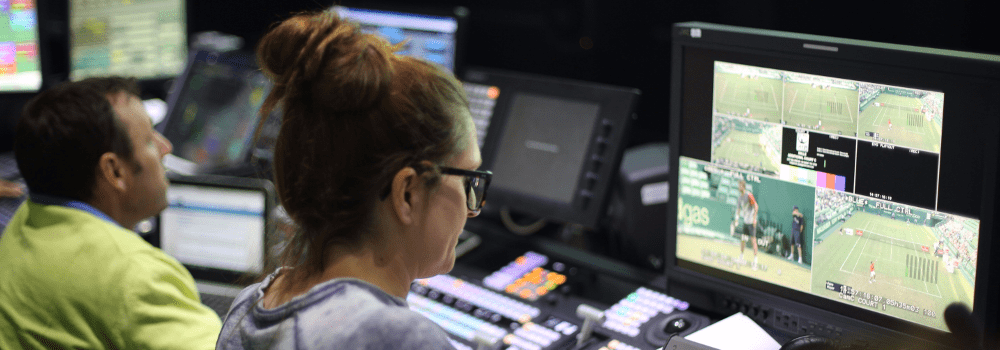
Much is currently made of the potential for remote production, and of course we see the potential of this, but given the geographical nature and limitations of the event sites and the cost of the connectivity we are using a hybrid model. For the ATP 500 series, we remotely produce the World Feed and additional courts using a select number of feeds from site in partnership with a domestic host broadcaster. As well as the live content we are able to deliver ENG footage shot by a small team on site to our remote hub for editing and upload to the Broadcast Portal. Also we remotely create our 52 minute Tournament Review Show that is aired within hours of the trophy presentation. The experience we gain from remotely producing these 12 tournaments gives us confidence to innovate further in this field as bandwidth limitations reduce and global telecommunications services advance.